Heritage

Heritage (or historic) painting is a genre in painting defined by its subject matter rather than artistic style. Heritage paintings usually depict a moment in a narrative story, rather than a specific and static subject, as in a portrait.

  • Thirty-Three-Metre Collage

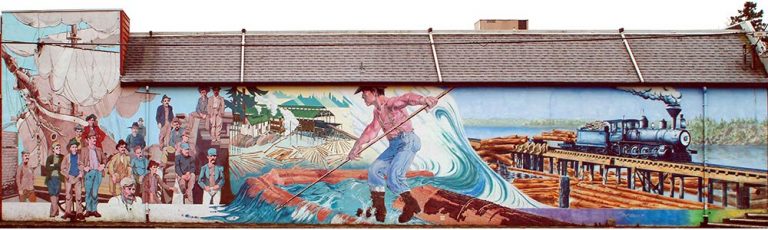
    On the left, a crew of stevedores at the Chemainus wharf stands before a fully rigged ship, her sails clewed up for drying. Based on a photograph from 1901, the scene is typical of the busy harbour on any given day. Sailing ships and steamers, as many as five at a time, would be loading or waiting to begin their ‘lay days’. At the centre, a boom man sorts logs in the slippery danger of the log dump. The mill is portrayed here as it was in 1892; it was the third operation to be built on the site. Owned by the Victoria Lumber & Manufacturing Co. Ltd., it was improved over the years until a fire destroyed it in 1923.
  • The Lone Scout

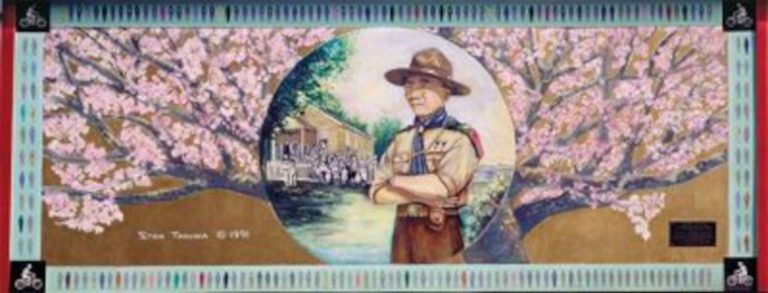
    Edward Shige Yoshida was born in Victoria, BC in 1908, and was raised in the quiet mill community of Chemainus.
    In 1929, he realized his dream in starting the 2nd Chemainus Boy Scouts, an all-Japanese Canadian troop and the first of its kind in the country. The delicate, porcelain plate quality of his portrait in the mural, The Lone Scout, belies the wit, energy and determination of this slightly built but significant character in the life of Chemainus.

  • Steam Donkey At Work

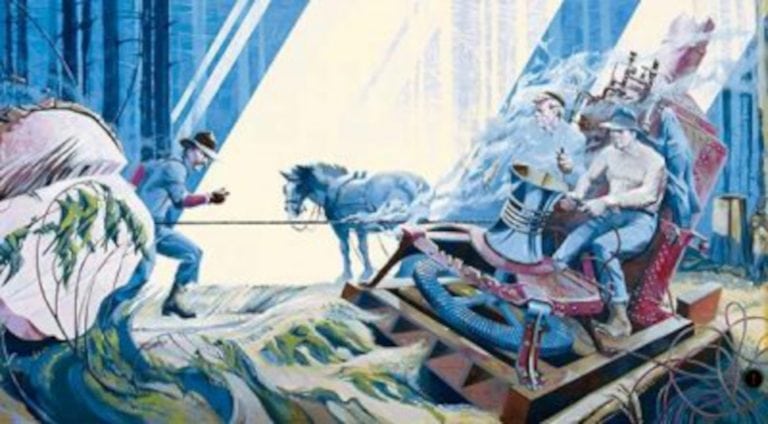
    The steam donkey was invented by John Dolbeer in 1882. The one in the mural was built by Murray Bros, in San Francisco and started work for the Victoria Lumber & Manufacturing Co. Ltd. (V L & M) in Chemainus in 1885. The painting is based on a photograph from 1902.

  • Supply Trains Here

    This mural depicts an early small town scene. Excursions to town were few and far between for homesteaders and ranching families. The arrival of the supply train provided an opportunity for people to socialize and get caught up on the latest news.

    Artist: Terry Gregoraschuk, 1991-92

  • Aviation History in High River

    The first mural (facing east) features squadron leader ‘Ack Ack Leitch’ one of Canada’s outstanding aviators and a long-time resident of High River. He was awarded both the Military Cross and the Distinguished Flying Cross. He was stationed in High River at the Air Station and was later promoted to Officer Commanding. The parachutists are Flight Lieutenant Carter, M.M. seen
    making the first local jump at the High River Air Station in 1926, and stunt man Roy Lomheim demonstrating his free-fall dive to students from the No. 5 Elementary Flying Training School in the 1940s. The south-facing mural shows an inspection at the No. 5 E.F.T.S. which operated on the former High River
    Air Station site from 1941 to 1944. The west-facing mural depicts an aerial fire patrol carried out by members of the Canadian Air Force who manned the High River Air Station, which opened in 1921. Carrier pigeons were used until ground to air communications were established.

    Artist: Doug Dreidiger, 1992-94

  • High River’s First Nurse

    Marie Meyer Davis was a trained nurse who lived and worked in the High River area from 1903 to 1939. She was an invaluable assistant to pioneer doctor Dr. G.D. Stanley, and accompanied him to many out-of-town cases, often driving
    the horse-drawn vehicle while he slept. During the 1918 influenza epidemic, when the doctor was too busy to make all the calls, she often worked alone.This mural was a joint legacy project between the 1996 High River Science Festival
    Committee and Science Alberta, and is a reminder of the significant contribution science makes to our everyday lives

  • Rt. Hon. Joe Clark

    High River native Joe Clark was Canada’s 16th and, at age 39, youngest Prime Minister. His family has deep roots in High River, where his Grandfather Charles Clark Sr. started the High River Times in 1905. His father Charles Clark Jr. then operated the Times from 1949 until he sold it in 1966 when Joe and his brother Peter decided to pursue other careers.

  • W.O. (Bill) Mitchell

    W.O. (Bill) Mitchell is one of Canada’s best-loved writers. His works include such Canadian classics as Who Has Seen the Wind and Jake and the Kid. Bill, his wife Merna, and their family lived in High River from 1944 to 1968 (except for three years when he was fiction editor at Macleans). Bill taught English, Social Studies and Drama at High River High School. Stories of Bill’s exploits in High River abound and he is fondly remembered by many locals. In later years, he and Merna lived mainly in Calgary, but they chose the High River Cemetery as
    their final resting place.

    Artist: J.M Compton, 1994

  • Fort Spitzee

    In the late 1800s, many whiskey traders from south of the border came to southern Alberta and set up trading forts where they exchanged liquor, arms, and ammunition for furs and buffalo hides. There were several forts on the Sheep and Highwood Rivers, but the largest was Fort Spitzee. There were at least two other posts also known as ‘Spitzee’. These posts proved to be disastrous for the
    First Nations people. In 1874, the North West Mounted Police were sent west by the Canadian government to put an end to the whiskey trade. Traders heard of their arrival, and abandoned the forts – often burning them to the ground as they left. Kneeling in the foreground is Jerry Potts, who was a guide for the NWMP.

    Artist: Terry Winter, 1992

  • The Opening of the High River Club

    In 1905, the club rooms of the newly-formed High River Club (so named in its official charter) were opened with a formal ball. Local ladies were dressed “to the nines” in the latest formal fashions. Local Natives wore their own finery
    for the proceedings. After one more formal reception, and a later visit by the fundraising Sisters of Lacombe Home, women never again graced the premises of what became known as the High River Men’s Club.

    Artist: Zhong Ru Huang, 2007

  • The Medicine Tree

    According to various sources the Blackfoot considered the unique Cottonwood tree to be a sign of prosperity with healing powers from the spirits. They often left offerings of food, tobacco and arrowheads beneath its branches as offerings to the spirits for good medicine and blessings on the land. It has also been said that the tree was believed to have spiritual and healing powers and was a favourite First Nations camping place.

    Artist: Brent Laycock, 1990

  • Old Woman’s Buffalo Jump

    The Old Women’s buffalo jump ( “Old” refers to the age
    of the jump) is located 13 km south of High River. It was
    discovered during a flash flood in 1952. Excavations in 1958/59 revealed bones and artifacts over 2000 years
    old. Before the Plains tribes had horses and guns, they
    would run herds of buffalo off steep cliffs. Warriors
    would wait below with arrows, knives and clubs to kill
    any animals which survived the fall.

    Artist: Steve Jones, 1990

  • The History of Theatre on Yonge Street

    In collaboration with the Chelsea Hotel and Downtown Yonge BIA, this mural showcases Yonge Street’s theatre scene over the past century. The wall stretches 145-feet long with images of theatres, props and actors depicted in horizontal panels to look like a film strip. Life-size patrons and children line the pedestrian sidewalk, while vintage cars are painted on on the street side. 4 panels include realistic facades of 4 different theatres that were painted in black and white to give a timeless feel that adds to the historical theme.

  • Sportifs

    La murale réalisée par Cécile Gariépy met en lumière le patrimoine sportif de la ville Mont-Royal. Elle est située sur le mur aveugle du club de curling de la ville. Il s’agit de notre troisième réalisation à ville Mont-Royal.
    This mural by Cécile Gariépy celebrates the Town of Mount Royal’s sports heritage. It is located on a wall of the town’s curling club. It is MU’s third project with the Town of Mount Royal.