First Schoolhouse, 1883
In 1883, the first public school in Chemainus was built next to the route of the E&N Railway. The mural is based on an 1885 photograph.

Heritage (or historic) painting is a genre in painting defined by its subject matter rather than artistic style. Heritage paintings usually depict a moment in a narrative story, rather than a specific and static subject, as in a portrait.

In 1883, the first public school in Chemainus was built next to the route of the E&N Railway. The mural is based on an 1885 photograph.

Many Chinese people had been enticed to the west coast of Canada as labourers in the late 1800s. A number settled in Chemainus with the promise of steady work in the lumber industry.
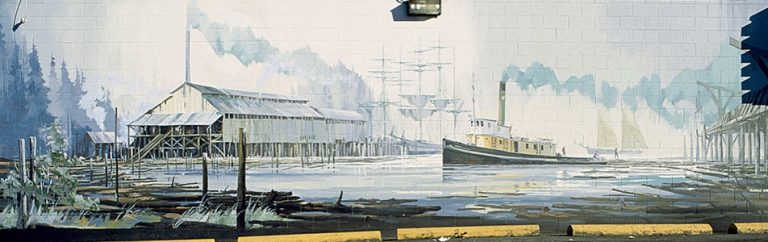
The tug boat Chemainus was built at Chemainus in 1909 for the Victoria Lumber & Manufacturing Co. Ltd. Equipped with a coal burning engine (this was changed to oil in the 1920s), she was 26.8 metres (93 ft) long with a 6.4 metre (22 ft) beam, and a depth of 2.9 metres (10 ft).
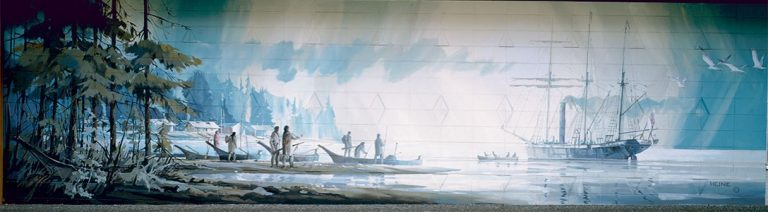
The gunboat HMS Forward was one of four such royal navy vessels dispatched during the search for the murderers of William Brady and the Marks family in April 1863.

William Ishmael (Billy) Thomas was born to William and Catherine Thomas in 1874. He was the first male child of European ancestry born in the Chemainus Valley and lived here for all of his 102 years. Following his father’s death in about 1878, his mother remarried William Alexander Miller. The log cabin fronting the Chemainus River, which had served as their home, was eventually replaced by a larger farmhouse. It was the house Billy would live in all his life.
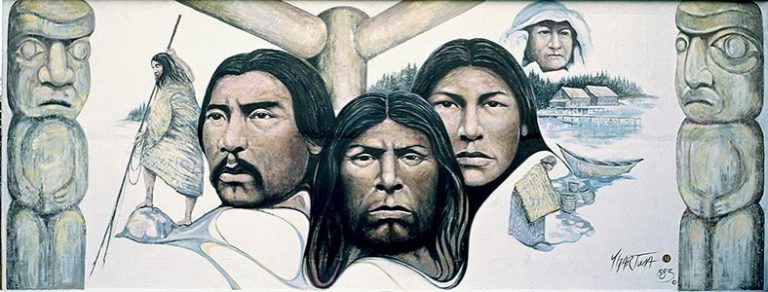
This immense mural is based on figures from the Native past and present in this area. Carved poles flank the central images of (left) Ce-who-latza, who was Chief of the Lyackson Village on Shingle Point, Valdes Island, as well as a constable of the Native Police and a Native pilot for the Royal Navy; (centre) former Chemainus Band Chief Clay-sa-luke; and (right), a Salish woman. One of the other figures is Mary Rice, top right.

Such rudimentary accommodation was not new to communities like Chemainus. Many early settlers to the area lived in similar tents for their initial stay, as they struggled to clear land and gather precious funds and materials to build better homes.
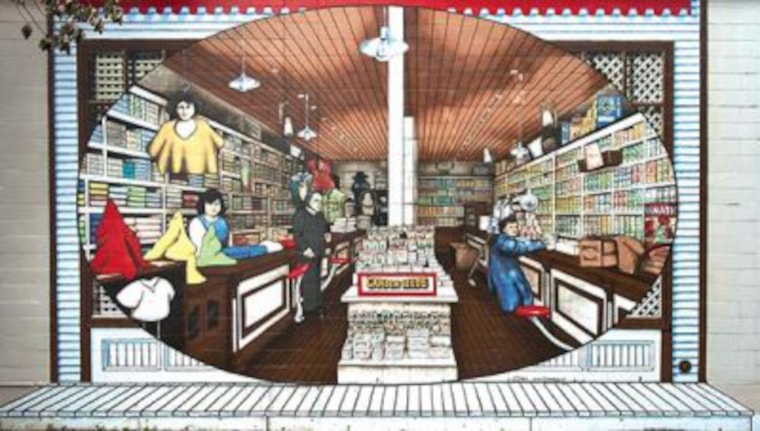
Using an oval format, this mural shows an interior depiction of the Victoria Lumber & Manufacturing Co. Ltd. store, circa 1917. The artist recreated the deep perspective of the colourfully laden shelves from old photographs. D.A. Gatus was the store manager. He is seen standing in the mid-ground. Ann Porter worked as a clerk and is pictured on the left behind the counter.

The mural shows the original Chemainus, then known as Horseshoe Bay. Passenger cars of the famous Esquimalt and Nanaimo Railway (E&N) steam their way across this scene of the settlement at Horseshoe Bay in 1891.
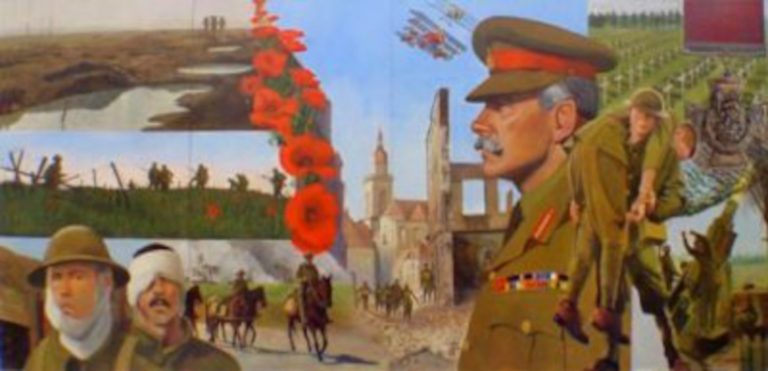
This mural depicts the heroism and sacrifice in First World War, the “Great War”. It speaks to the suffering of ordinary men in the trenches and elsewhere. The artist’s son and a friend posed in rented uniforms to depict the soldier at right, carrying his wounded officer.
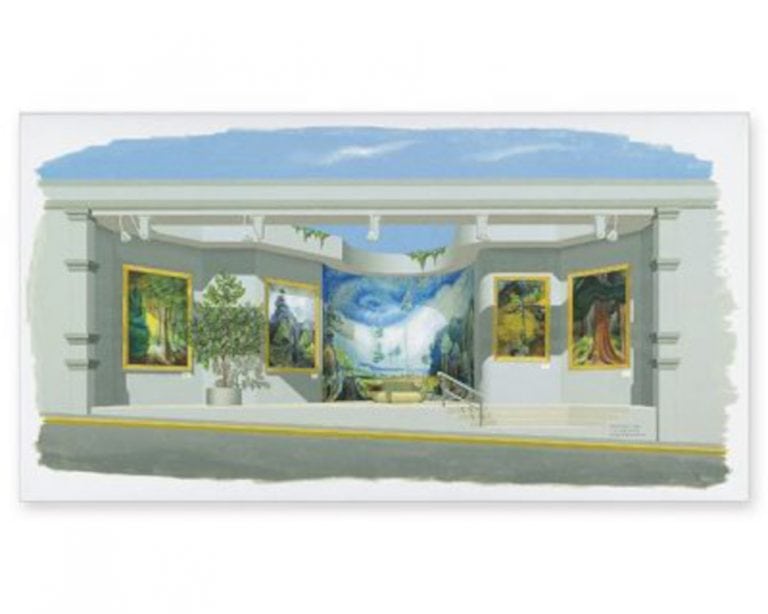
Jünemann employed Trompe L’oeil, an art technique that employs extremely realistic imagery to create a three dimensional perception, by way of an optical illusion. Note the illusion of stairs leading up to an imaginary art gallery displaying Emily Carr’s framed paintings.
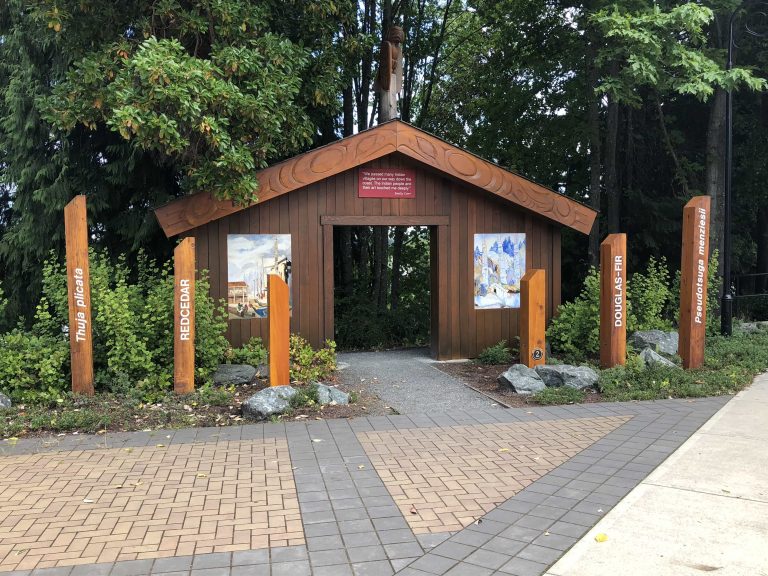
This freestanding structure, designed by Carey Newman, features the front of a traditional longhouse. It is complete with an open doorway as the door is always open to the Big House.
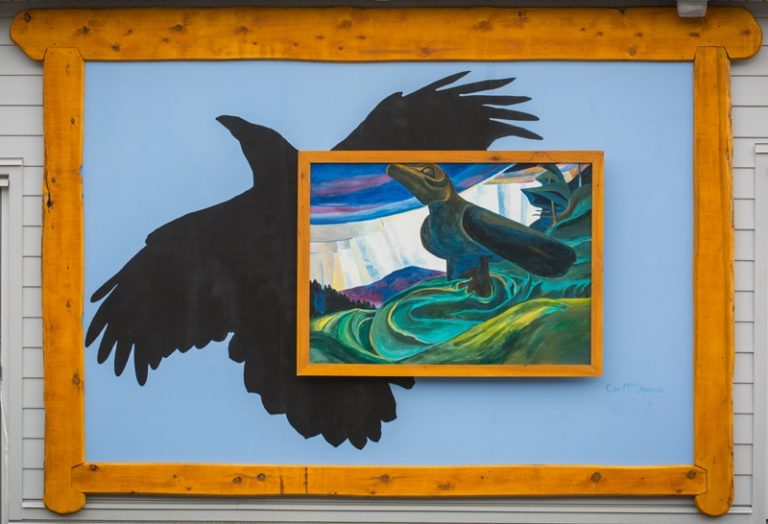
The raven is an important symbol in First Nations cultures of the Northwest Coast. The bird stole the sun, moon, and stars for humans, bringing light to the world.
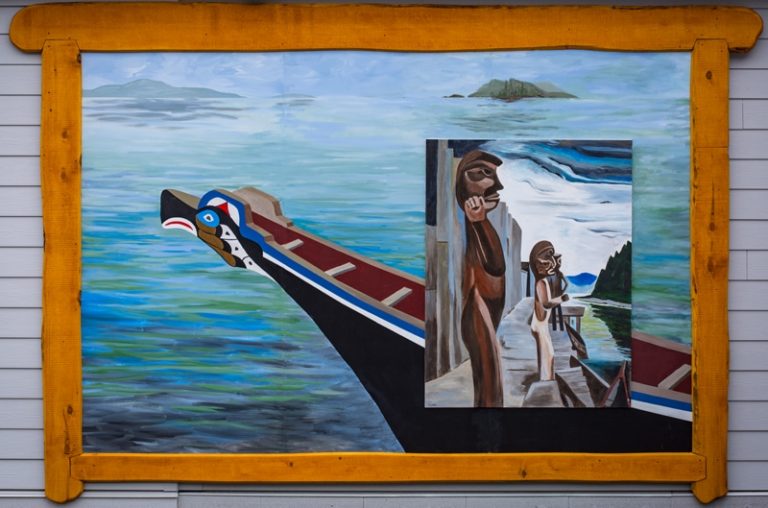
The canoes and totems featured in this mural were carved from cedar. Cedar had a special significance in the culture and traditions of the Northwest Coast First Nations.
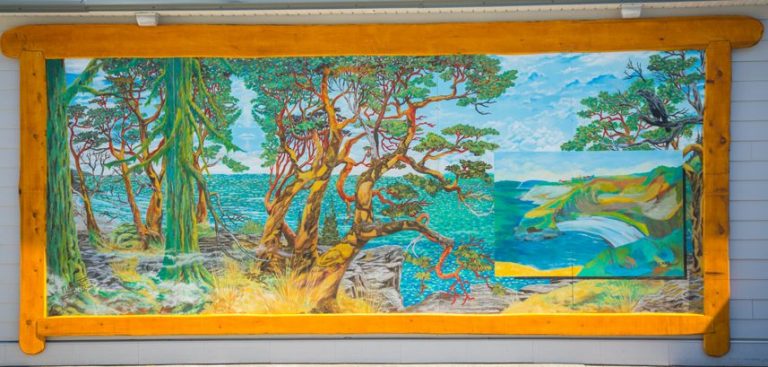
The vistas from the shores of Vancouver Island have always captivated residents and visitors alike. The Arbutus trees featured in this mural are native to the Pacific Northwest. The tree is the only broadleaf evergreen tree in Canada.
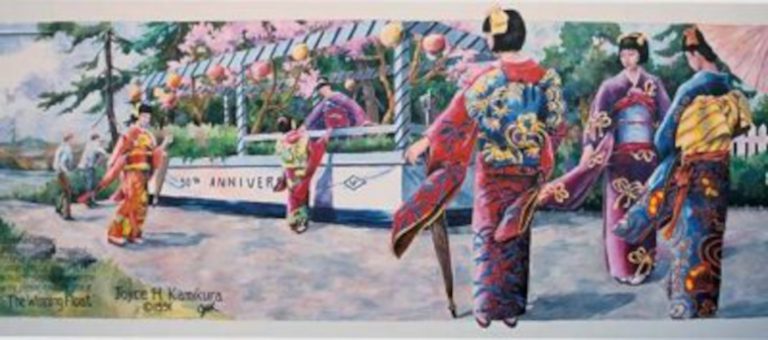
In the summer of 1991, special efforts were undertaken to commemorate the rich and valuable contribution of Japanese Canadians to the community of Chemainus. “The Winning Float” is a result of those efforts and pays tribute to citizens who so long ago took such joy in celebrating our history.
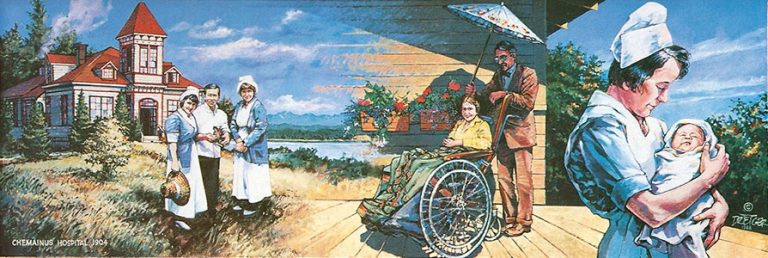
In a composite of scenes, Chemainus Hospital, built in 1899, sits majestically at the left of the mural. When built, it was the only hospital between Victoria and Nanaimo. It remains a strong focus in the community even today. Some of the doctors, nurses, staff and patients from over the years are portrayed in the foreground across the expanse of the mural. From left to right are: Nurse Graham, Head Cook Chang, Nurse Johnson, Ruth Heslip (wheelchair), Dr. Herbert Burritt Rogers, and Nurse MacDougal, holding an infant.
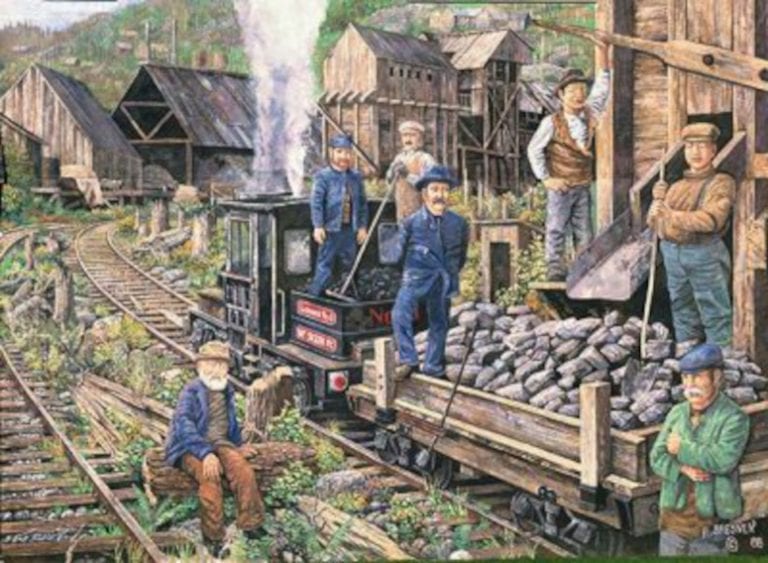
On May 16, 1897, Harry Smith and a partner staked the famous Lenora claim, named after Smith’s only daughter. That began the development of Mt. Sicker as a copper mining centre. The price of copper was high, and two other companies opened mines in the area
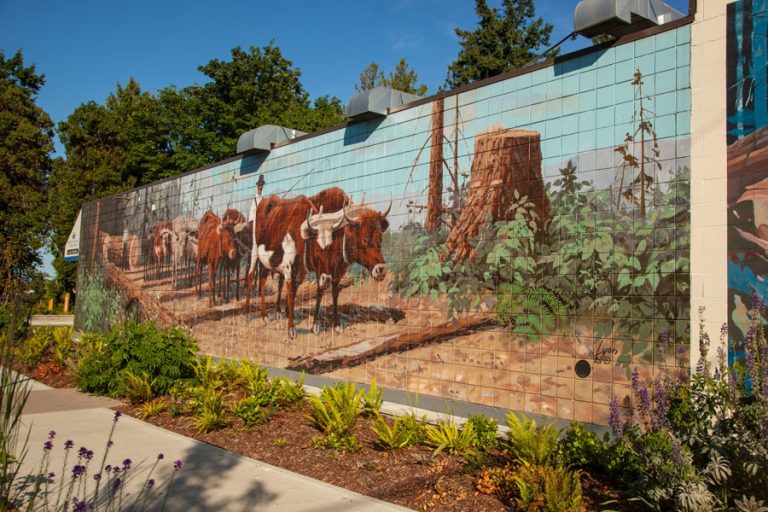
Around 1898, oxen were the main form of power in logging, where good timber was available. “Large, well-equipped outfits used twenty to twenty-four oxen. These were divided into two teams: one drawing the logs from the bush to the road, while the other and stronger team was employed in skidding the logs to the water. Crude roads were built and small logs embedded skillfully athwart them at 8-foot intervals. These were the skid-roads over which the oxen drew the logs to the sea.” (R.I. Dougan, from Cowichan My Valley).
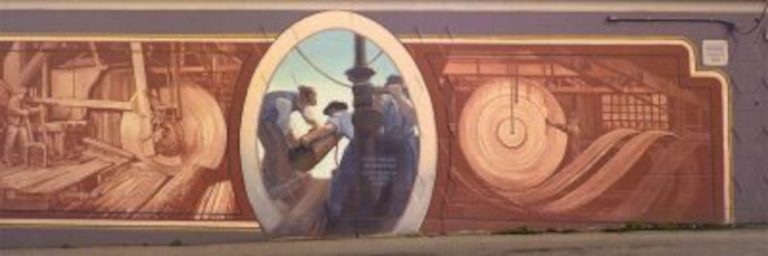
The central theme of this expansive triptych is that of the mill and its workers anticipating the end of a shift with the sounding of the handsomely crafted steam-operated whistle. Sombre greens and blues mark the dying light of an evening in summer.
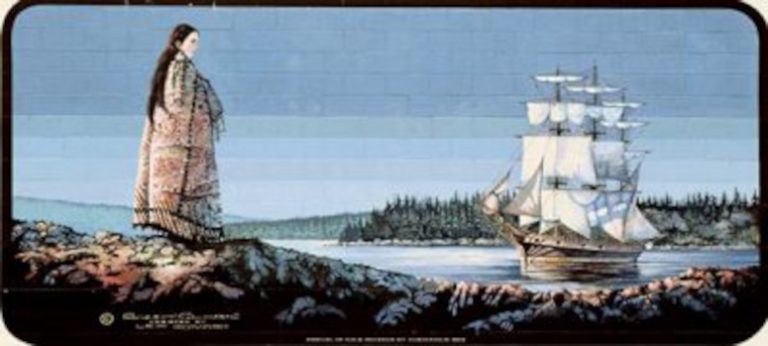
A luminescent cedar bark cloak envelops the figure of a Native princess as she contemplates the arrival of the sloop Her Majesty’s Ship Reindeer. The ship’s commander, Captain A.E. Kennedy, was an acquaintance of Isabel and Thomas George Askew, pioneers of Chemainus and mill owners for many years.

Working as a team, fallers cutting a coastal giant fir had to stand at the same elevation. This was made almost impossible by the rough ground and steep slopes of the rainforest. To overcome the difference in heights, and to get above the massive flaring butt of a tree, springboards were used.
Made from yellow cedar planks, and iron tipped, these were wedged into notches in the tree. Each faller would stand upon a springboard and wield his double-edged falling axe with precision.
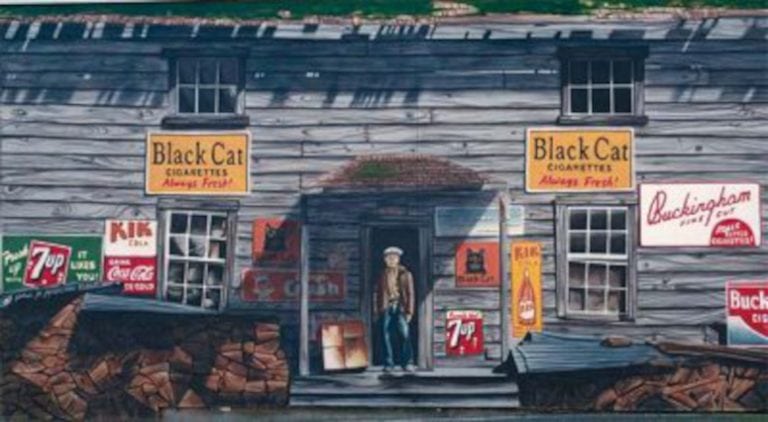
Fong Yen Lew was known to almost everyone as Hong Hing, the name he gave to his store. Born in the late 1800s, he came to Canada and set up his business in Chemainus around 1915. His enterprise began as a laundry, but he later sold groceries, chickens and second-hand goods. Eventually, he expanded into bootlegging and running a gambling house.
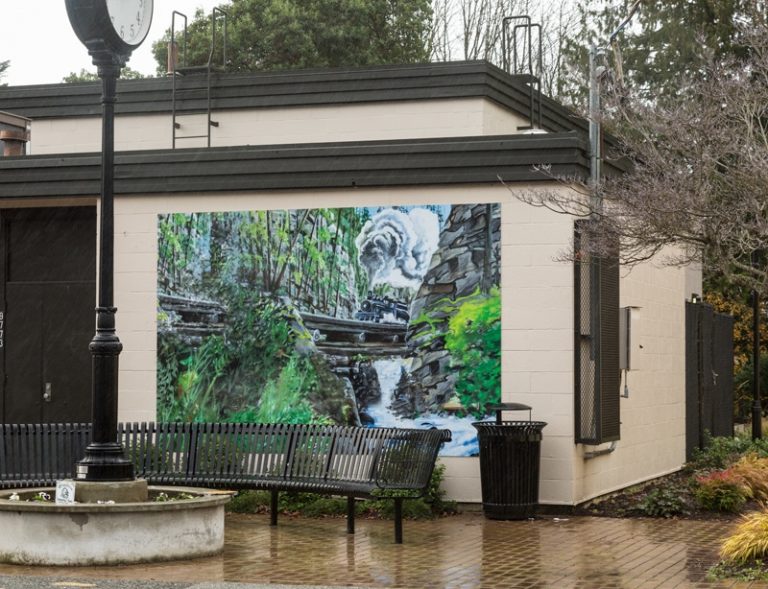
Thundering across a log bridge over the Chemainus River is Locomotive No. 4, an 80-ton Porter 2-6-2T, once the pride of the Victoria Lumber & Manufacturing Co. Ltd.’s Copper Canyon Railway System. Chemainus was the delivery point of the first, the last, and the longest enduring rail logging operation in BC. After the Chemainus Fire Hall was demolished in2015, the mural was recreated on aluminum composite panels and installed on the TELUS Building on Will Street.
Sign up for our newsletter to get the latest news and events delivered straight to your inbox.
I have read and agreed to the Privacy Policy and the Terms of Service.
I understand that I can unsubscribe at any time by clicking the unsubscribe link in the Mural Routes newsletter.