705 Broadway Mural
This mural was installed on Aboriginal Day in 2007, and is made of various ceramic tiles. Memengwa translates to butterfly in Ojibwe.

Indigenous mural art, painted by First Nations, Métis, and Inuit people, reflects their contemporary and traditional values, stories, experiences, and ideas.

This mural was installed on Aboriginal Day in 2007, and is made of various ceramic tiles. Memengwa translates to butterfly in Ojibwe.

This mural was created in partnership with the Winnipeg Art Gallery, and was guest curated by former WAG curator Jamie Issac.

Mural created by the students of Hugh John MacDonald Middle School.

The murals honour missing and murdered Indigenous women, this dedication coming from Lavallee learning more about the 1971 murder of Helen Betty Osborne. This star blanket encases a University of Winnipeg facility, the Wii Chiiwaakanak Learning Centre, home to Indigenous education and cultural programming.

O Kanata is about celebrating the role of Indigenous Peoples, and honouring the beauty of Canada’s natural landscapes.

The mural depicts a scene of the Red River Ex, a yearly travelling fair which occurs at Winnipeg’s Assiniboia Downs. Within the imagery, there is a strong emphasis on Manitoba’s responsibilities to Indigenous children and communities within the province.

A 5-panel piece created by Bill Oster and David Ashley in 1997.
Called “Crow’s Yukon Journey”, it illustrates Crow’s journey over the developing Yukon.

The fire in the design is a metaphor for the gross destruction caused by colonization and the Indian Residential and Day Schools and the devastating genocide of our people and ways of being. The land and the water prevail and ensure healing and restoration of wealth. Reconnecting to our lands and waters and all their ancient wisdom is restoring our health and wealth.

A celebration of animal companions. This mural, painted by artist Siobhan Joseph, is located on the wall of a vet clinic, and features three animals the clinic most often services: a dog, a turtle, and a parrot.

The geometric shapes cascading around the figure mimic threads passing through time, crafting the fabric of history. This continuity is central to the mural; the ancestors role in shaping the culture and its future.

A depiction of unconditional love, blessings, and kindness, this mural is the product of a collaboration between two Indigenous artists, featuring three distinct art styles: Anishinaabe, Cree, and Coast Salish.

Artist Jordan Gallie hails from the Tsleil-Waututh nation, one of three nations whose ancestral and unceded land includes what is known today as Vancouver and the surrounding inlets, forests, and mountains.

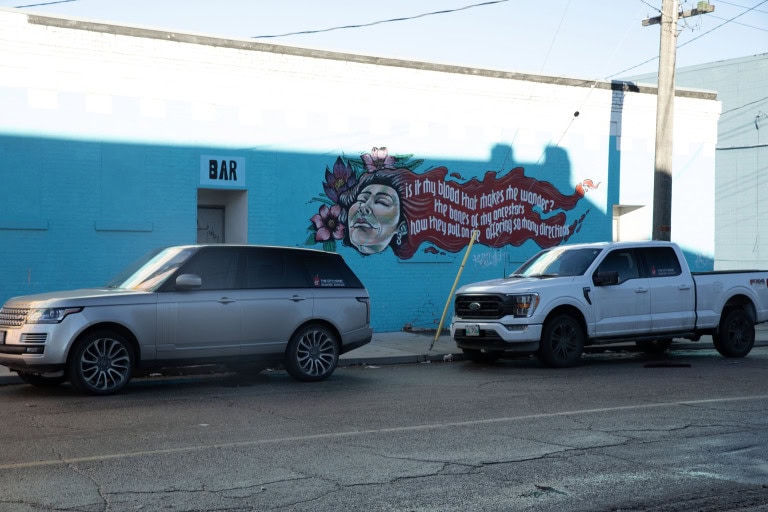
Winner of Mural of the Year 2016, this mural depicts a woman mending a ripped heart with thread. It represents the unity of First Nations peoples, from the South to the North. The muskox on her hat relate to how these animals protect their young from predators. The vamps on her poncho are symbols for the missing and murdered Indigenous women in Canada, and it highlights the severity of this issue in this particular area of Winnipeg. The act of heart mending occurs every day, in various ways whether it be physical or spiritual, we are all on a process of healing.

This mural was painted by Patrick Thompson and Alexa Hatanka; an art duo known as PA System.
One of two murals on the Sutherland Hotel.

This mural completely covers the outer surface of Sutherland Hotel.

Cunningham is a Portland-based artist whose work has been exhibited internationally for the last 20 years. His art deals with themes of environmental degradation, skateboard culture, gentrification, contemporary Indigenous identity and rights. Mostly working with large format murals, Cunningham also uses film and sculpture as mediums, drawing inspiration from his cultural background as a member of the Colville Tribe.

Artist Siobhan Joseph from the Squamish Nation was inspired by her late mother, the matriarch of her family, who was outspoken, who protested, and loved children. Joseph had a vision of a woman standing in a welcoming pose, with a man and elder woman on either side representing the men and elders of her community supporting her. The matriarch is depicted wearing red to honour the Missing and Murdered Indigenous Women (MMIW) and situated in the natural landscape of the land, mountains and sea, to represent connectedness.

A partnership between the Vancouver Mural Festival, Nicola Wealth Real Estate, and The Narrow Group to transform an iconic Vancouver motel into a temporary art space, landmark, and community event venue before the site is redeveloped. Three artists with different styles collaborated to transform the motel into a single mural stretching across the exterior of the building which now houses artist studios.

The content’s positive/impactful in a way it isn’t direct. Art is healing through form/flow/colour/aesthetic all subjective to the artist. Im going to leave perspective on current multi-generational reality that impact communities and people worldwide. It’s bright side as strong as I can express it through my style and spirit: through the art of our culture. Homes, (healthy functioning homes) are safe, sober, clean, strong and productive…loyal, nurturing and unified, (like this design.) A lot of people lost that from their lives. The house design-split-eagle-box represents everything negative and positive, balancing negative/positive spaces and opening up with the guidance of eagle reveals the movement of spirit bringing healing and nourishment to soul.

19 Indigenous artists between the ages of 9-55 created 19 murals in a series titled “Our Stories.” Positioned on the exterior wall of Scotia Square, each mural is unique and tells its own story. These murals were created over the span of five workshops.

This mural was a part of Astum Api Niikinaahk, an Indigenous-led housing project at Circle of Life Thunderbird House, the goal of the project to end and bring attention to homelessness. Five Indigenous artists were invited to create public art for the new housing site.

This mural was a part of Astum Api Niikinaahk, an Indigenous-led housing project at Circle of Life Thunderbird House, the goal of the project to end and bring attention to homelessness. Five Indigenous artists were invited to create public art for the new housing site.

This mural was a part of Astum Api Niikinaahk, an Indigenous-led housing project at Circle of Life Thunderbird House, the goal of the project to end and bring attention to homelessness. Five Indigenous artists were invited to create public art for the new housing site.
Sign up for our newsletter to get the latest news and events delivered straight to your inbox.
I have read and agreed to the Privacy Policy and the Terms of Service.
I understand that I can unsubscribe at any time by clicking the unsubscribe link in the Mural Routes newsletter.