Acahkos
On south facing wall of K & K Auto Repair Centre
Part Mural Massive Festival

Indigenous mural art, painted by First Nations, Métis, and Inuit people, reflects their contemporary and traditional values, stories, experiences, and ideas.

On south facing wall of K & K Auto Repair Centre
Part Mural Massive Festival

Large scale mural dedicated to missing, murdered & Indigenous people of Turtle Island by local artist Que Rock. Supported by STLC Next. Commissioned by TO Live for the St. Lawrence Centre for the Arts Redevelopment Project. Completed in 2022.

Located above the main entrance to the Centre de la francophonie.
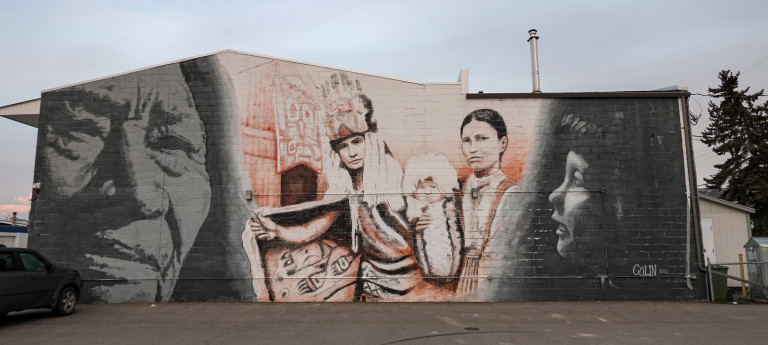
Mural depicts a First Nation family and two shadowed faces of a child and an elder.

There is a old tug boat on the snow that has the web address Mackay.ca on it. The web address no longer is active and reroutes to a different website.
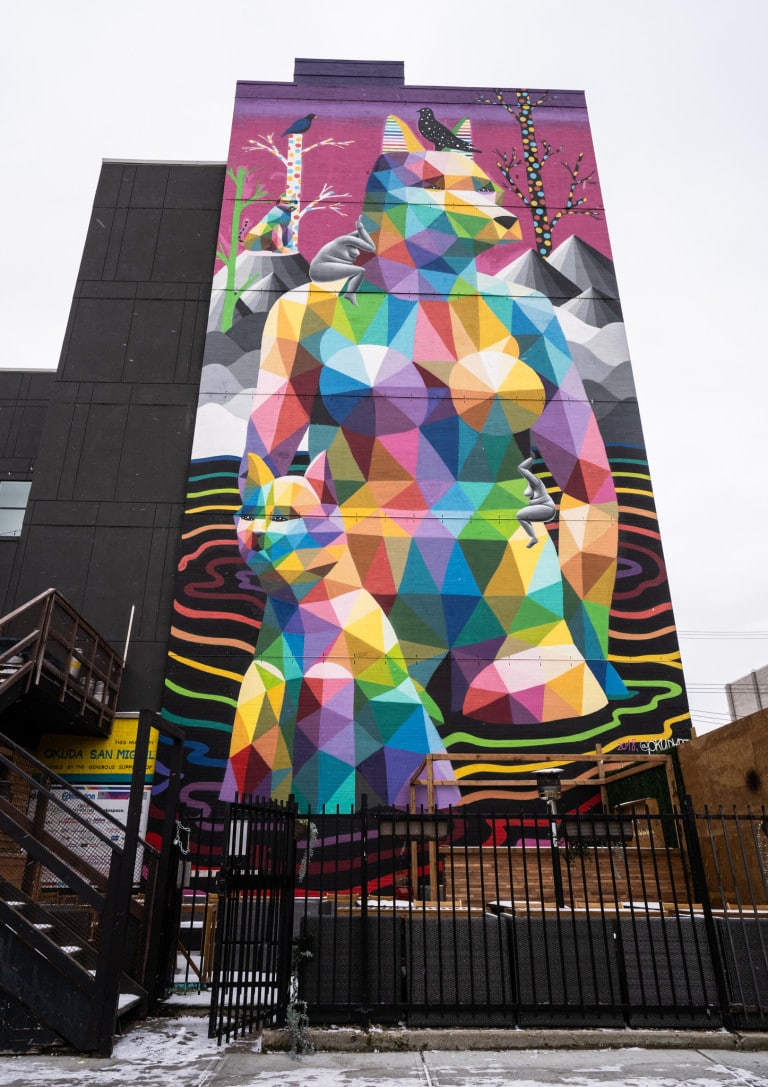
It’s like a mix between geometric language with different patterns, digital parts with organic parts… something like that. The Edmonton mural, for which Alberta is supposed to serve as the inspiration, should last forever although some colours may fade somewhat from exposure to sunlight.

‘The Hero’ mural, crafted by the artistic talents of Hardthirteen, Trevor Peters, and Annaliza Toledo, not only ranks as their largest creation but also signifies a monumental achievement for EMF. It is a striking work of art, radiating both immense presence and boundless inspiration.

Part of YYC BUMP (Beltline Urban Murals Project)
Graffiti Jam of 2021 at High Park rooftop

Aurora Bell Box mural by Karen Roberts & Sharon Rigby as a response to Call to Action #83 from the Truth & Reconciliation Commission Report. Mural is based on the an Iroquois Star Creation Story.

Aurora Bell Box mural by Hope Flynn & Gloria Hope as a response to Call to Action #83 from the Truth & Reconciliation Commission Report. Features a turtle with the text “13 Moons on a Turtles Back.”

Aurora Bell Box mural by Gloria Hope & ACC/CMHA team as a response to Call to Action #83 from the Truth & Reconciliation Commission Report.

Aurora Bell Box mural by Kim Egan & Jennifer Messon as a response to Call to Action #83 from the Truth & Reconciliation Commission Report.

Aurora Bell Box mural by Stacey Kinder & Jennifer Messon as a response to Call to Action #83 from the Truth & Reconciliation Commission Report.

Aurora Bell Box mural by Joaquin Varela & Annwin Manitowabi as a response to Call to Action #83 from the Truth & Reconciliation Commission Report.

Aurora Bell Box mural by Jill Sciberras & Ren Lonechild as a response to Call to Action #83 from the Truth & Reconciliation Commission Report. From Ren Lonechild’s instagram: “We created an image of Mother Earth telling a story of the creation of Turtle Island and the spirits who watch over it.”

Bell Box mural by Atessa Hooshvar & Sharon Rigby for the “Truth & Reconciliation” initiative located on 11 Mosley St. “A woven tapestry of indigenous and non-indigenous art.”

Bell Box mural located in Aurora by Sherlyn Hu & Ren Lonechild. From Sherlyn’s Instagram: “I’m honored to complete a Bell Box Mural with the talented @renlonechild bringing together a storytelling of Indigenous and Chinese cultures. Ren’s story depicts the sharing of knowledge from Mother Earth. Sherlyn’s story speaks to the inter generational love through symbols like a warm bowl of soup, set against Mid-Autumn festival when we celebrate family reunion.”

Both the images and sound work exist synergistically, centered on ideas of intra-actions, entanglements, enfoldings and assemblies. The image informs the language and the language is built from the image. Each image was constructed based on the conceptual framework of the Anishinaabemowin, being an agglutinative language, is built upon the fragments of other words or morphemes. This lends itself to an incredibly rich framework from which the speaker can precisely and eloquently express and manifest a complexity of worlds. The fluidity inherent in the language forms a critical method from which to consider the cyclical process of assemblies/[dis]assemblues and [dis]memberments/ rememberances. That is, the space and movement between these spectra are the generative spaces that inform this work.

The translation of Ninikan (Ni-nican ) meaning ‘I am here’ in Nahuatl is a mantra I’ve come to know and use in my Indigenous reclamation process and also how I acknowledge the presence of my ancestors here and now. The word Ninikan resonates for me because despite it taking me some time to get here, they have always been waiting here for me to hold space for them, as they have always held space for me. In acknowledging their presence, it has given me the authority to claim my Mesoamerican lineage and add meaning to the visual language of this piece through the incorporation of Indigenous body movements and the celebration of my pre-columbian ancestors. This scene depicts a tender moment between myself and my ancestor at night, when the veil and connection is the strongest and the sacuanjoche flowers are in full bloom and most fragrant.

Mural on a shipping container store by Philip Cote at Stackt Market, 2023. Mural is of a thunderbird in Woodland style, based on the indigenous story of the thunderbird who brought down rain, lightning and thunder.

Double sided planter mural as tribute to residential school children. Features a boy and girl in residential school uniform and cut hair. The school is in the backdrop but around the children are flowers and on the sides of the planter feature burning sage and sweet grass with a pine tree in the background, and medicine wheels beside it. Research and consultation was done to be culturally appropriate. By FPMONKEY, 2021

Garage door
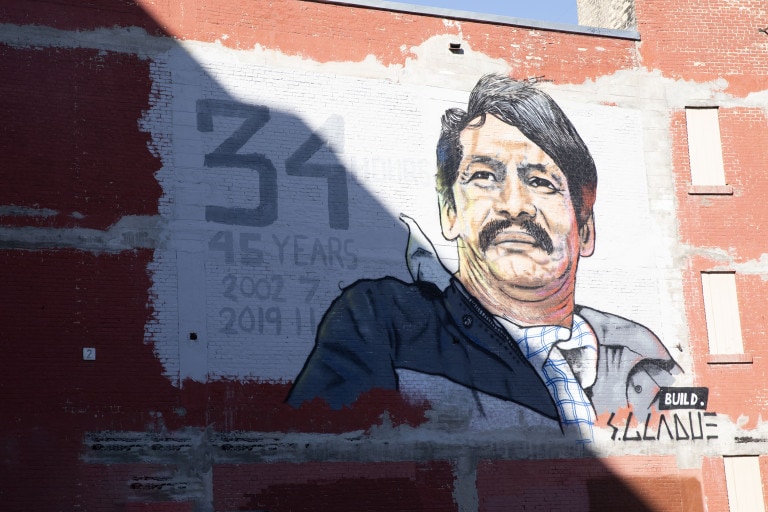
This mural depicts a portrait of Indigenous man Brian Sinclair, who died in 2008 while waiting to be seen in emergency at Health Sciences Centre. Sinclair, with a treatable infection was killed by racism, and wasn’t discovered dead until 34 hours after his arrival. He was only 45 when he died. His death was a wake-up call for many Winnipegers and for the Winnipeg Regional Health Authority, who then planned to implement more recommendations, and take accountability for anti-racist policies in healthcare.

This mural was unveiled on Aboriginal Day in 2005, and is located on the side of the Indigenous & Northern Affairs Canada Building, also known as the New Hargrave Building or the Film Exchange Building. The mural itself is on a vinyl material, and it celebrates and represents the contribuions that Indigenous people have made in furthering the nation.
Sign up for our newsletter to get the latest news and events delivered straight to your inbox.
I have read and agreed to the Privacy Policy and the Terms of Service.
I understand that I can unsubscribe at any time by clicking the unsubscribe link in the Mural Routes newsletter.