Second Chemainus Sawmill
This sawmill was the second to be built on the same site. Constructed in 1879 by T.G. Askew, it was converted to steam power by Croft & Severne in 1883. The mural is based on a photograph in 1886.

Mural Locations

This sawmill was the second to be built on the same site. Constructed in 1879 by T.G. Askew, it was converted to steam power by Croft & Severne in 1883. The mural is based on a photograph in 1886.

In a panoramic view of Chemainus Harbour, this mural captures the colourful memories of the old logging community. Lumber is stacked up along the far hill, waiting to be loaded onto the tall ships and steamers at anchor in the harbour. Chemainus Hospital appears on the left.

This painting is a montage of historic buildings and events in the area between 1883 and 1939.

The first building on the left of old Mill Street was used as a Post Office until 1927. That year, streetlights made their first appearance in Chemainus, with power provided by the V L & M Co. Ltd.

Julia Askew was the first of seven children born in Chemainus to Thomas George and Isabel Julia Askew. An older brother was born in Victoria two years earlier, but Julia was the first child actually born in the young community of Chemainus. She was delivered on February 22, 1871 at Horseshoe Bay, with a Native midwife in attendance.

In 1883, the first public school in Chemainus was built next to the route of the E&N Railway. The mural is based on an 1885 photograph.

Many Chinese people had been enticed to the west coast of Canada as labourers in the late 1800s. A number settled in Chemainus with the promise of steady work in the lumber industry.
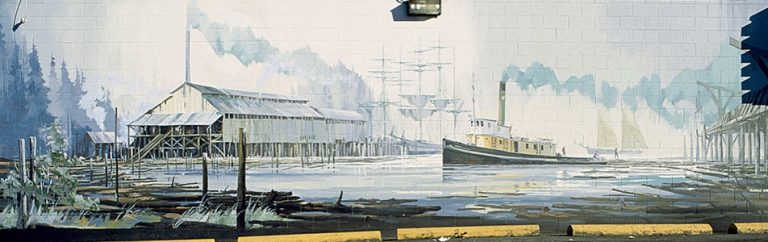
The tug boat Chemainus was built at Chemainus in 1909 for the Victoria Lumber & Manufacturing Co. Ltd. Equipped with a coal burning engine (this was changed to oil in the 1920s), she was 26.8 metres (93 ft) long with a 6.4 metre (22 ft) beam, and a depth of 2.9 metres (10 ft).
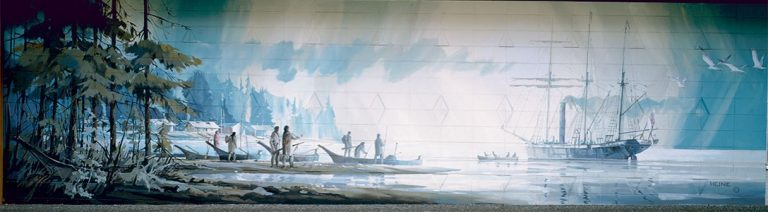
The gunboat HMS Forward was one of four such royal navy vessels dispatched during the search for the murderers of William Brady and the Marks family in April 1863.

William Ishmael (Billy) Thomas was born to William and Catherine Thomas in 1874. He was the first male child of European ancestry born in the Chemainus Valley and lived here for all of his 102 years. Following his father’s death in about 1878, his mother remarried William Alexander Miller. The log cabin fronting the Chemainus River, which had served as their home, was eventually replaced by a larger farmhouse. It was the house Billy would live in all his life.
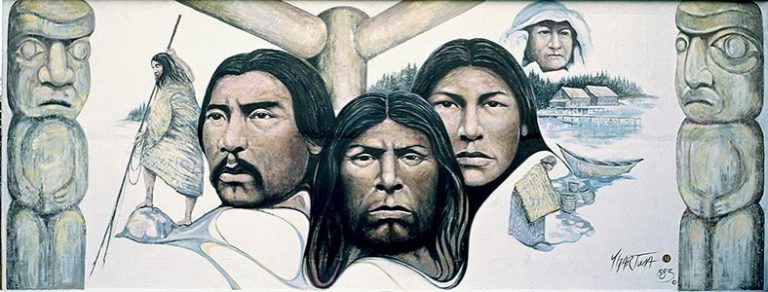
This immense mural is based on figures from the Native past and present in this area. Carved poles flank the central images of (left) Ce-who-latza, who was Chief of the Lyackson Village on Shingle Point, Valdes Island, as well as a constable of the Native Police and a Native pilot for the Royal Navy; (centre) former Chemainus Band Chief Clay-sa-luke; and (right), a Salish woman. One of the other figures is Mary Rice, top right.

Such rudimentary accommodation was not new to communities like Chemainus. Many early settlers to the area lived in similar tents for their initial stay, as they struggled to clear land and gather precious funds and materials to build better homes.
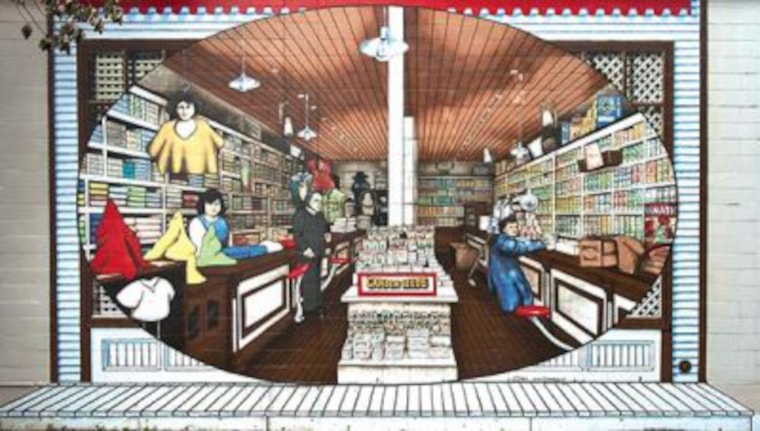
Using an oval format, this mural shows an interior depiction of the Victoria Lumber & Manufacturing Co. Ltd. store, circa 1917. The artist recreated the deep perspective of the colourfully laden shelves from old photographs. D.A. Gatus was the store manager. He is seen standing in the mid-ground. Ann Porter worked as a clerk and is pictured on the left behind the counter.

Loggers at the V L & M Co. Ltd. Camp 2 (circa 1902) would spend part of their Sundays around the bunkhouse. It was the day for washing up and tending to one’s personal grooming. Half barrels and 18.18 litres (four gal) coal oil cans were used as washtubs, while a rail spike keg made a great barber’s chair.

The mural shows the original Chemainus, then known as Horseshoe Bay. Passenger cars of the famous Esquimalt and Nanaimo Railway (E&N) steam their way across this scene of the settlement at Horseshoe Bay in 1891.
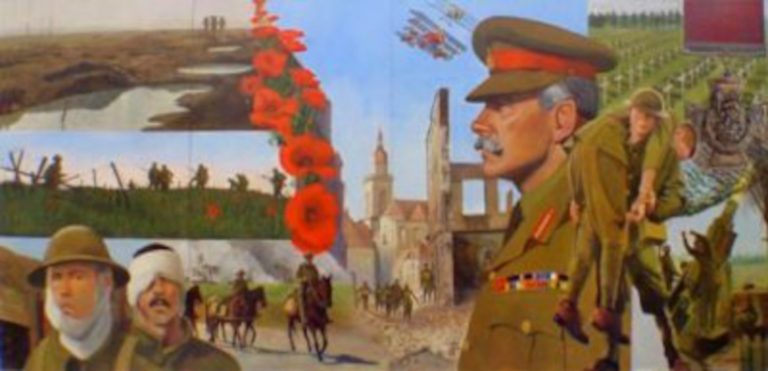
This mural depicts the heroism and sacrifice in First World War, the “Great War”. It speaks to the suffering of ordinary men in the trenches and elsewhere. The artist’s son and a friend posed in rented uniforms to depict the soldier at right, carrying his wounded officer.
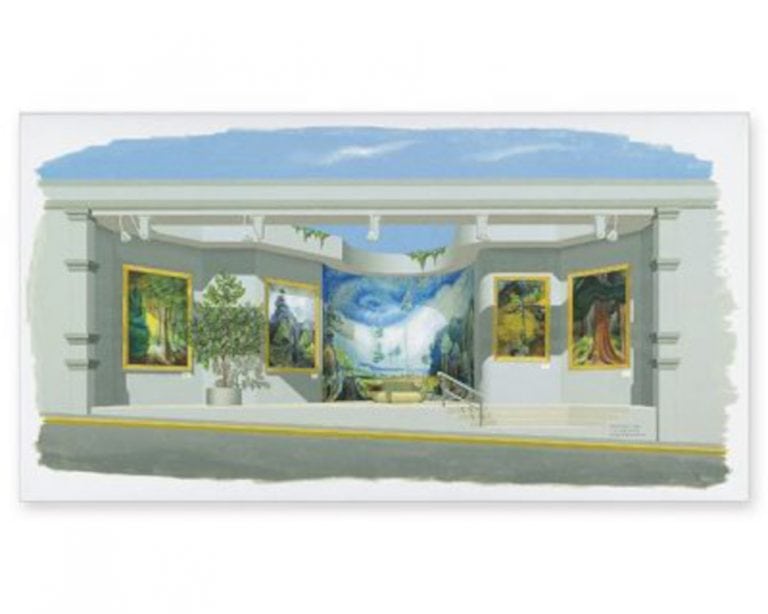
Jünemann employed Trompe L’oeil, an art technique that employs extremely realistic imagery to create a three dimensional perception, by way of an optical illusion. Note the illusion of stairs leading up to an imaginary art gallery displaying Emily Carr’s framed paintings.
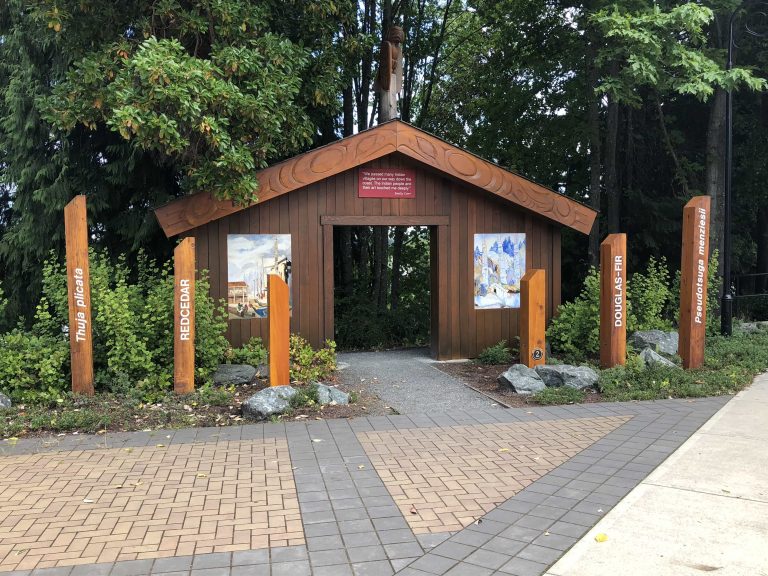
This freestanding structure, designed by Carey Newman, features the front of a traditional longhouse. It is complete with an open doorway as the door is always open to the Big House.
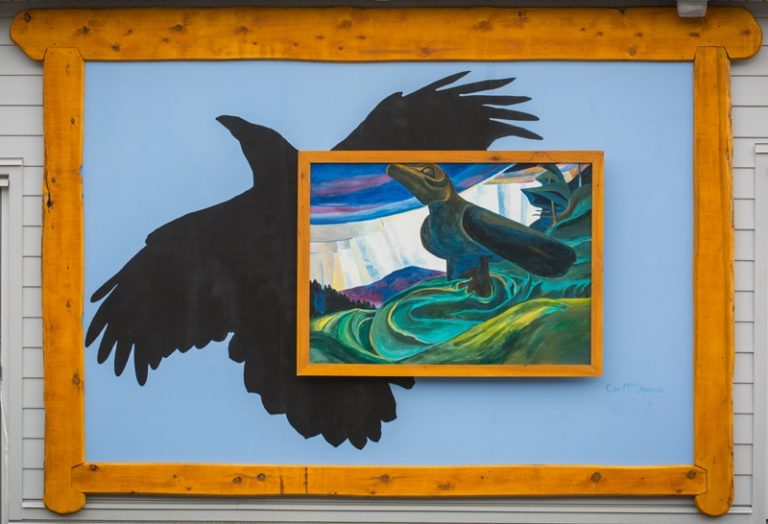
The raven is an important symbol in First Nations cultures of the Northwest Coast. The bird stole the sun, moon, and stars for humans, bringing light to the world.
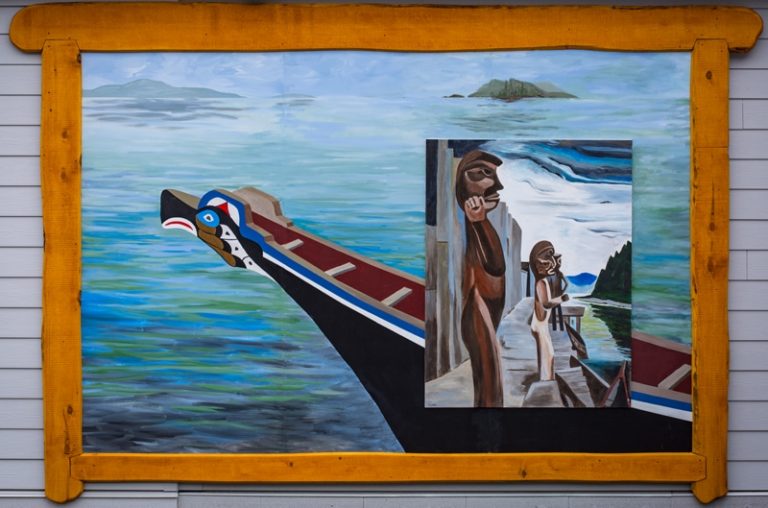
The canoes and totems featured in this mural were carved from cedar. Cedar had a special significance in the culture and traditions of the Northwest Coast First Nations.
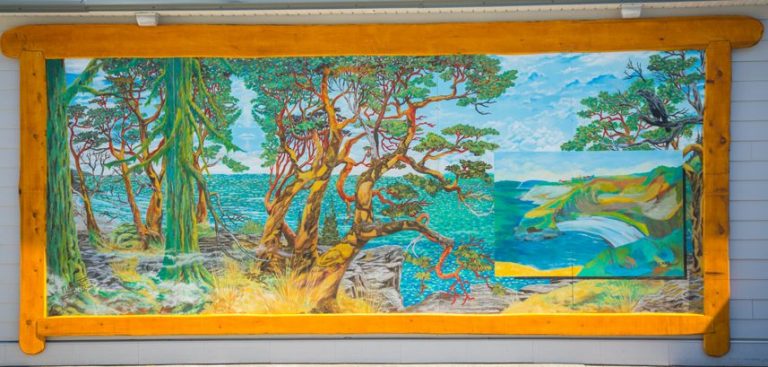
The vistas from the shores of Vancouver Island have always captivated residents and visitors alike. The Arbutus trees featured in this mural are native to the Pacific Northwest. The tree is the only broadleaf evergreen tree in Canada.
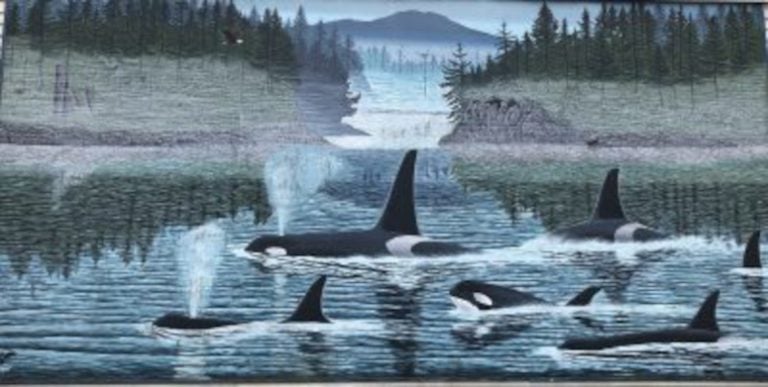
These majestic orcas swim off the coast of Vancouver Island. The largest members of the oceanic dolphin family, their first scientific description was in 1558.
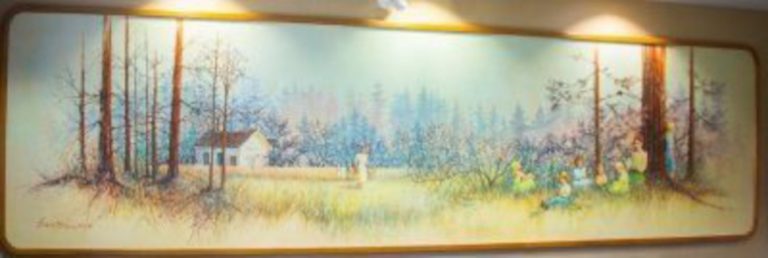
This mural evokes memories of a bygone time; the days of schoolhouses, where teachers taught children of all ages in one room. It portrays a lesson out in the meadow, under the trees.

Chemainus has long been a destination for seafaring peoples, originally with the Coastal Salish First Nations, to the first European explorers between the 1770s and 1800, and the first settlers who arrived in the late 1850s. To celebrate those who have had a long association with the coastal waters and those who are still arriving, the Municipality of North Cowichan asked Chemainus Festival of Murals Society curator Cim MacDonald to create a compass at Kin Beach.
Sign up for our newsletter to get the latest news and events delivered straight to your inbox.
I have read and agreed to the Privacy Policy and the Terms of Service.
I understand that I can unsubscribe at any time by clicking the unsubscribe link in the Mural Routes newsletter.