Chemainus Labyrinth
The Chemainus Labyrinth in Waterwheel Square, in the Breamore design, of the medieval style, is the latest addition to the approximately 75 labyrinths on Vancouver Island.

Mural Locations
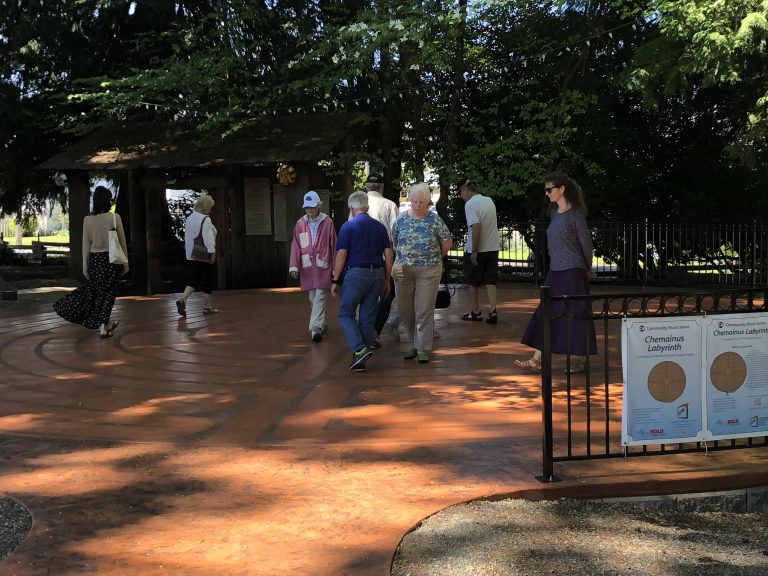
The Chemainus Labyrinth in Waterwheel Square, in the Breamore design, of the medieval style, is the latest addition to the approximately 75 labyrinths on Vancouver Island.

A mural depicting a protest against a 3-cent increase in chocolate bars.

Piano In A Box is the working title for the newest piece in the Chemainus Festival Of Murals Society’s outdoor art collection.
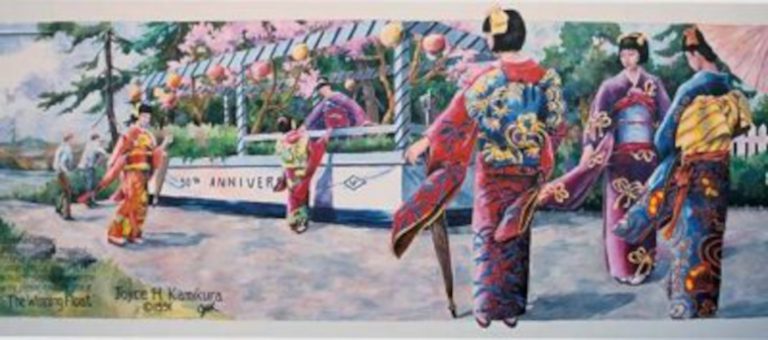
In the summer of 1991, special efforts were undertaken to commemorate the rich and valuable contribution of Japanese Canadians to the community of Chemainus. “The Winning Float” is a result of those efforts and pays tribute to citizens who so long ago took such joy in celebrating our history.
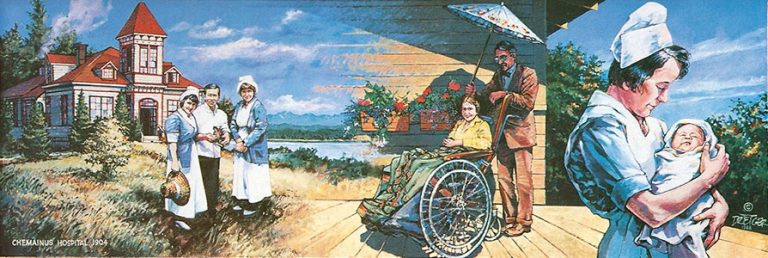
In a composite of scenes, Chemainus Hospital, built in 1899, sits majestically at the left of the mural. When built, it was the only hospital between Victoria and Nanaimo. It remains a strong focus in the community even today. Some of the doctors, nurses, staff and patients from over the years are portrayed in the foreground across the expanse of the mural. From left to right are: Nurse Graham, Head Cook Chang, Nurse Johnson, Ruth Heslip (wheelchair), Dr. Herbert Burritt Rogers, and Nurse MacDougal, holding an infant.
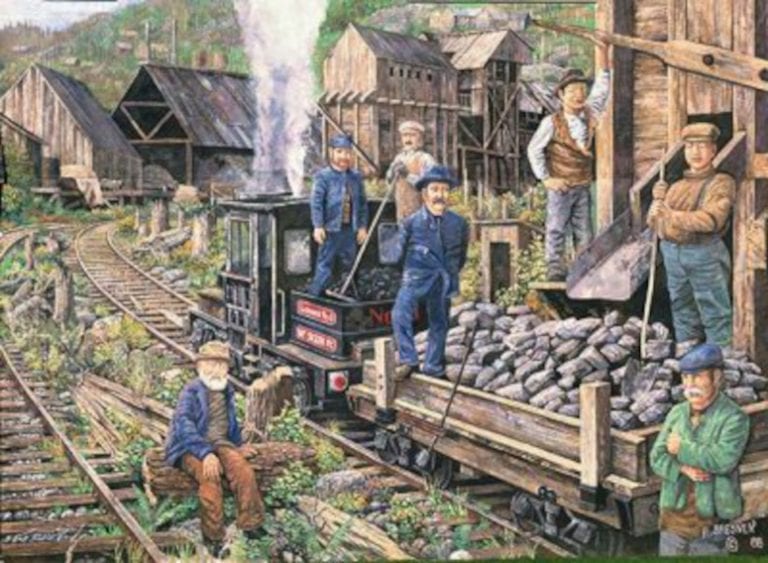
On May 16, 1897, Harry Smith and a partner staked the famous Lenora claim, named after Smith’s only daughter. That began the development of Mt. Sicker as a copper mining centre. The price of copper was high, and two other companies opened mines in the area
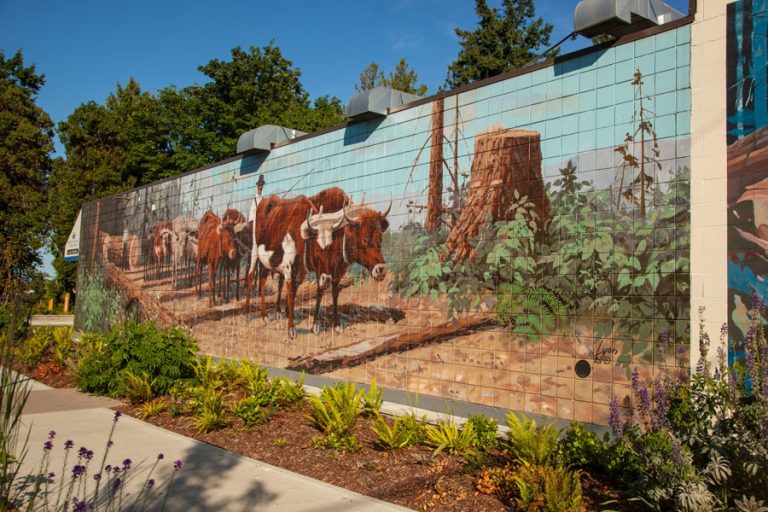
Around 1898, oxen were the main form of power in logging, where good timber was available. “Large, well-equipped outfits used twenty to twenty-four oxen. These were divided into two teams: one drawing the logs from the bush to the road, while the other and stronger team was employed in skidding the logs to the water. Crude roads were built and small logs embedded skillfully athwart them at 8-foot intervals. These were the skid-roads over which the oxen drew the logs to the sea.” (R.I. Dougan, from Cowichan My Valley).
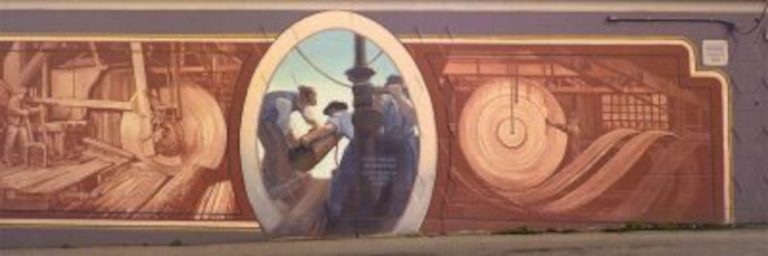
The central theme of this expansive triptych is that of the mill and its workers anticipating the end of a shift with the sounding of the handsomely crafted steam-operated whistle. Sombre greens and blues mark the dying light of an evening in summer.
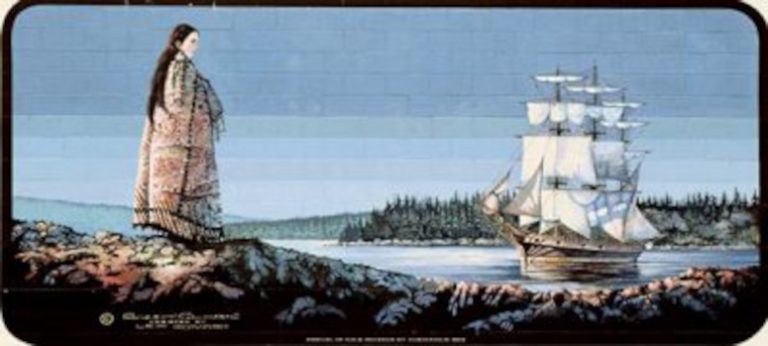
A luminescent cedar bark cloak envelops the figure of a Native princess as she contemplates the arrival of the sloop Her Majesty’s Ship Reindeer. The ship’s commander, Captain A.E. Kennedy, was an acquaintance of Isabel and Thomas George Askew, pioneers of Chemainus and mill owners for many years.

Working as a team, fallers cutting a coastal giant fir had to stand at the same elevation. This was made almost impossible by the rough ground and steep slopes of the rainforest. To overcome the difference in heights, and to get above the massive flaring butt of a tree, springboards were used.
Made from yellow cedar planks, and iron tipped, these were wedged into notches in the tree. Each faller would stand upon a springboard and wield his double-edged falling axe with precision.
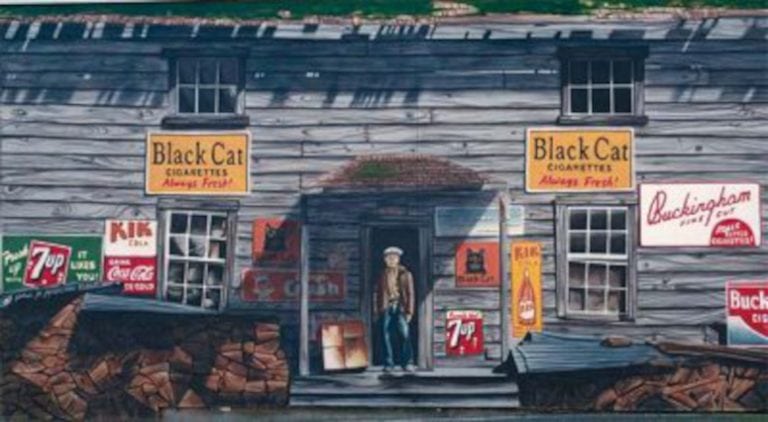
Fong Yen Lew was known to almost everyone as Hong Hing, the name he gave to his store. Born in the late 1800s, he came to Canada and set up his business in Chemainus around 1915. His enterprise began as a laundry, but he later sold groceries, chickens and second-hand goods. Eventually, he expanded into bootlegging and running a gambling house.
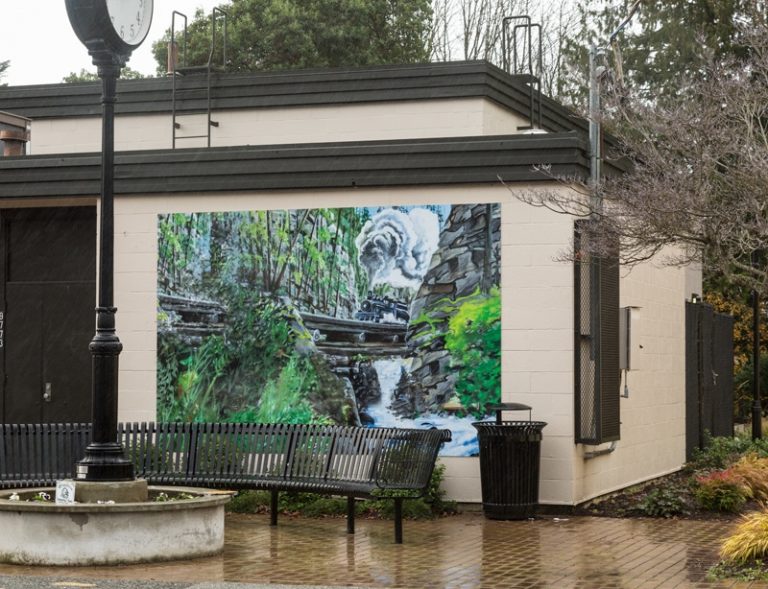
Thundering across a log bridge over the Chemainus River is Locomotive No. 4, an 80-ton Porter 2-6-2T, once the pride of the Victoria Lumber & Manufacturing Co. Ltd.’s Copper Canyon Railway System. Chemainus was the delivery point of the first, the last, and the longest enduring rail logging operation in BC. After the Chemainus Fire Hall was demolished in2015, the mural was recreated on aluminum composite panels and installed on the TELUS Building on Will Street.
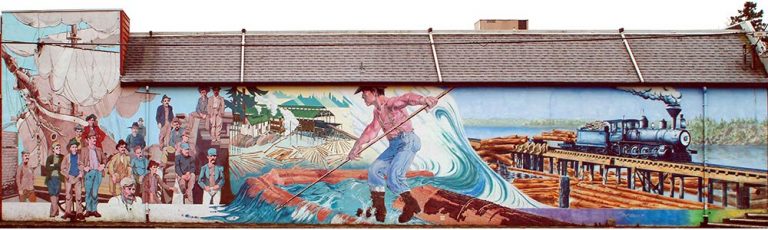
On the left, a crew of stevedores at the Chemainus wharf stands before a fully rigged ship, her sails clewed up for drying. Based on a photograph from 1901, the scene is typical of the busy harbour on any given day. Sailing ships and steamers, as many as five at a time, would be loading or waiting to begin their ‘lay days’. At the centre, a boom man sorts logs in the slippery danger of the log dump. The mill is portrayed here as it was in 1892; it was the third operation to be built on the site. Owned by the Victoria Lumber & Manufacturing Co. Ltd., it was improved over the years until a fire destroyed it in 1923.
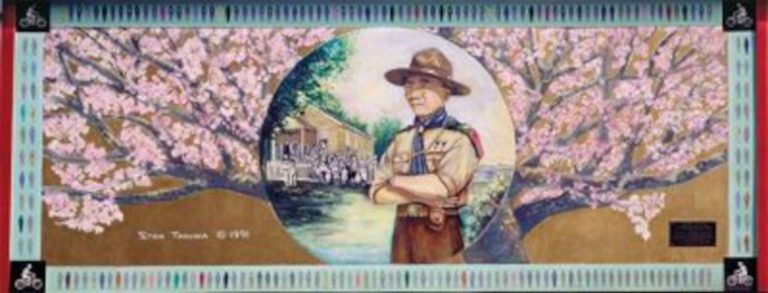
Edward Shige Yoshida was born in Victoria, BC in 1908, and was raised in the quiet mill community of Chemainus.
In 1929, he realized his dream in starting the 2nd Chemainus Boy Scouts, an all-Japanese Canadian troop and the first of its kind in the country. The delicate, porcelain plate quality of his portrait in the mural, The Lone Scout, belies the wit, energy and determination of this slightly built but significant character in the life of Chemainus.
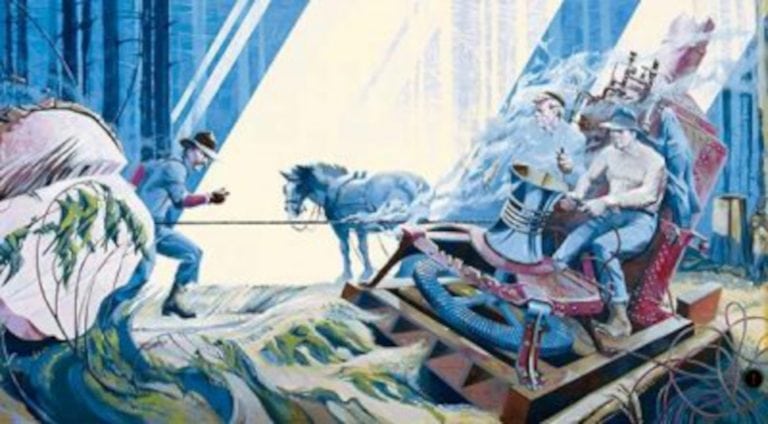
The steam donkey was invented by John Dolbeer in 1882. The one in the mural was built by Murray Bros, in San Francisco and started work for the Victoria Lumber & Manufacturing Co. Ltd. (V L & M) in Chemainus in 1885. The painting is based on a photograph from 1902.

Spitzee Crossing was the only accessible place to cross the Highwood River on the old Macleod Trail from Fort Macleod to Calgary. In 1886, when flood waters made the river impassable, Buck Smith built and operated a ferry. A bridge replaced the ferry in 1887
Artist: STEVEN JONES, 1994

The design reflects the unity of the community working together to move forward through spirit and determination. Bold paint strokes encompass a background of a heart, entwined with the horses’ legs to reflect the strength of the herd, young life and new roots. The design was selected by the community from artist submissions from across Canada.
Artist: MICHELLE LOUGHERY, 2016

The mural embraces the concept of community spirit joining together in the celebration of renewal. Featuring a sunny local landscape, a diverse community of dancers invite the viewer in. An inner circle of children, protected by the dancers represent hope, joy and growth for the future. Hot air balloons speckle the sky – a nod to our annual Balloon Festival.
Artist: ALEX PAVLENKO, 2016

10 emerging artist where hired to participate.
A few round panels depict historical events of East York.
The mosaic was created with recycled material.
Date: August 2016
Lead artist: Cristina Delago
East End Arts

This mural depicts an early small town scene. Excursions to town were few and far between for homesteaders and ranching families. The arrival of the supply train provided an opportunity for people to socialize and get caught up on the latest news.
Artist: Terry Gregoraschuk, 1991-92

The first mural (facing east) features squadron leader ‘Ack Ack Leitch’ one of Canada’s outstanding aviators and a long-time resident of High River. He was awarded both the Military Cross and the Distinguished Flying Cross. He was stationed in High River at the Air Station and was later promoted to Officer Commanding. The parachutists are Flight Lieutenant Carter, M.M. seen
making the first local jump at the High River Air Station in 1926, and stunt man Roy Lomheim demonstrating his free-fall dive to students from the No. 5 Elementary Flying Training School in the 1940s. The south-facing mural shows an inspection at the No. 5 E.F.T.S. which operated on the former High River
Air Station site from 1941 to 1944. The west-facing mural depicts an aerial fire patrol carried out by members of the Canadian Air Force who manned the High River Air Station, which opened in 1921. Carrier pigeons were used until ground to air communications were established.
Artist: Doug Dreidiger, 1992-94

Marie Meyer Davis was a trained nurse who lived and worked in the High River area from 1903 to 1939. She was an invaluable assistant to pioneer doctor Dr. G.D. Stanley, and accompanied him to many out-of-town cases, often driving
the horse-drawn vehicle while he slept. During the 1918 influenza epidemic, when the doctor was too busy to make all the calls, she often worked alone.This mural was a joint legacy project between the 1996 High River Science Festival
Committee and Science Alberta, and is a reminder of the significant contribution science makes to our everyday lives

High River native Joe Clark was Canada’s 16th and, at age 39, youngest Prime Minister. His family has deep roots in High River, where his Grandfather Charles Clark Sr. started the High River Times in 1905. His father Charles Clark Jr. then operated the Times from 1949 until he sold it in 1966 when Joe and his brother Peter decided to pursue other careers.

W.O. (Bill) Mitchell is one of Canada’s best-loved writers. His works include such Canadian classics as Who Has Seen the Wind and Jake and the Kid. Bill, his wife Merna, and their family lived in High River from 1944 to 1968 (except for three years when he was fiction editor at Macleans). Bill taught English, Social Studies and Drama at High River High School. Stories of Bill’s exploits in High River abound and he is fondly remembered by many locals. In later years, he and Merna lived mainly in Calgary, but they chose the High River Cemetery as
their final resting place.
Artist: J.M Compton, 1994
Sign up for our newsletter to get the latest news and events delivered straight to your inbox.
I have read and agreed to the Privacy Policy and the Terms of Service.
I understand that I can unsubscribe at any time by clicking the unsubscribe link in the Mural Routes newsletter.