Heritage

Heritage (or historic) painting is a genre in painting defined by its subject matter rather than artistic style. Heritage paintings usually depict a moment in a narrative story, rather than a specific and static subject, as in a portrait.

  • The Matriarch

    Artist Siobhan Joseph from the Squamish Nation was inspired by her late mother, the matriarch of her family, who was outspoken, who protested, and loved children. Joseph had a vision of a woman standing in a welcoming pose, with a man and elder woman on either side representing the men and elders of her community supporting her. The matriarch is depicted wearing red to honour the Missing and Murdered Indigenous Women (MMIW) and situated in the natural landscape of the land, mountains and sea, to represent connectedness.

  • Between Two Islands

    A partnership between the Vancouver Mural Festival, Nicola Wealth Real Estate, and The Narrow Group to transform an iconic Vancouver motel into a temporary art space, landmark, and community event venue before the site is redeveloped. Three artists with different styles collaborated to transform the motel into a single mural stretching across the exterior of the building which now houses artist studios.

  • Eagle Opens Up

    The content’s positive/impactful in a way it isn’t direct. Art is healing through form/flow/colour/aesthetic all subjective to the artist. Im going to leave perspective on current multi-generational reality that impact communities and people worldwide. It’s bright side as strong as I can express it through my style and spirit: through the art of our culture. Homes, (healthy functioning homes) are safe, sober, clean, strong and productive…loyal, nurturing and unified, (like this design.) A lot of people lost that from their lives. The house design-split-eagle-box represents everything negative and positive, balancing negative/positive spaces and opening up with the guidance of eagle reveals the movement of spirit bringing healing and nourishment to soul.

  • Portage and Main Barrier Mural

    The barriers at Winnipeg’s famous intersection Portage Avenue and Main Street were painted for a project titled “Pulse.” This title refers to what all individuals have in common, no matter their ethnicity or background. The artist took inspiration from those who passed through the intersection, which reminded him of the tradition of weaving. This multi-cultured practice is reflected in the design of the mural in the various diagonal lines.

  • BLM – Spirit of the Ladder

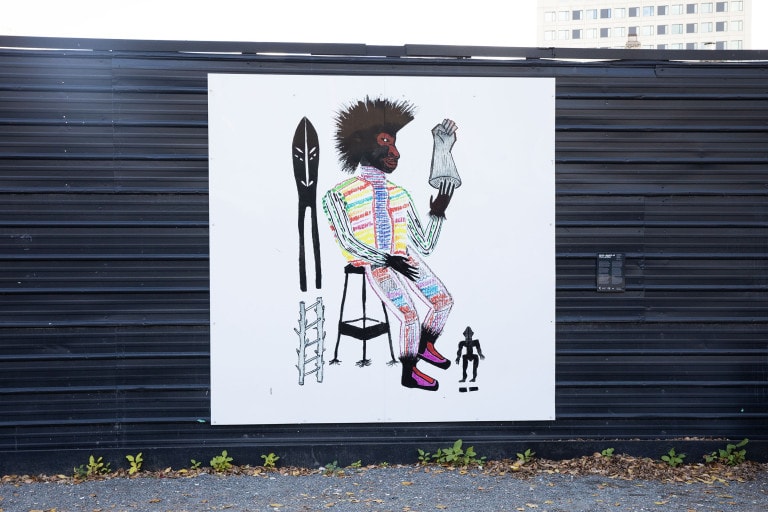
    My works are made on various supports, such as paper, cloth, acrylic, self-sticking vinyl for cloth, magazine clippings, newspapers, as well as objects found that were consecutively attached to the works. In some cases, I use digital assemblies, my own images and images from the web, and scan organic and inorganic objects found on public roads and integrate them to my works. These digital/manual collages, stencils, illustrations, prints, looms and sculptures are not intended to explore unknown worlds, but rather to setup a connection with the imaginary that founded my childhood in Colombia, the memory of blackness and recreation of myths that left an imprint on my identity. These works also seek to build the story of a mythical landscape I use color and build characters based on the recreation of ancient myths according to my perspective of the world. The invisible stuff of my works are dreams, stories and objects of my childhood, as well as fears and images that appeal me from the Pacific Ocean and the dense forest I used to cross to get to the mountains. Those experiences remain dormant, like a second skin in my senses. The images that I create are a fickle body that speaks for itself by whispering their own universe where my hands screen their bodies.

  • N/A

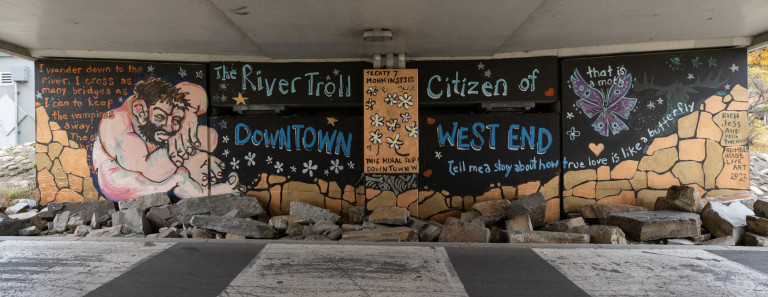
    The mural represents the “Indigenous significance of the Inglewood area where the Bow and Elbow rivers meet, recognizing past and present, the existing vibrant community and a connected future through stewardship of the land.”

  • Ohkoi’sski

    The mural has two separate but connected pieces.

    First, the mural on the wall depicts eagle feathers, animal tracks, and the confluence of the Elbow and Bow Rivers. Both artists felt the symbolism in the mural mattered most.

    The eagle feather is the feather of a golden eagle that has lost its spots and is now an adult eagle.

  • Along the Bow

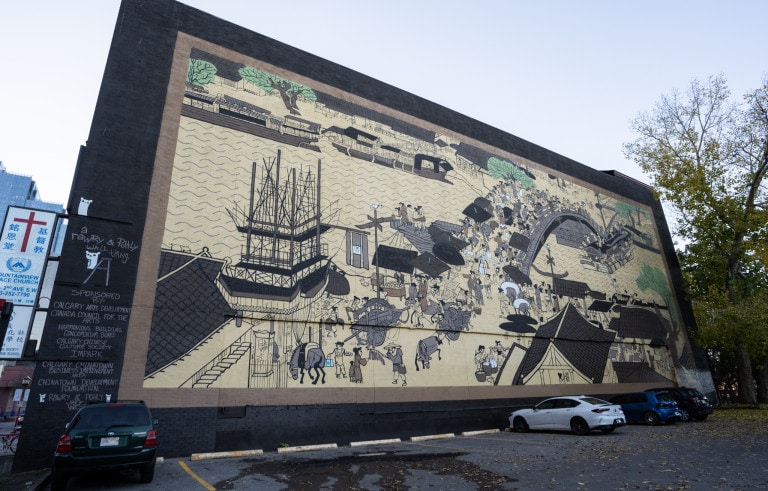
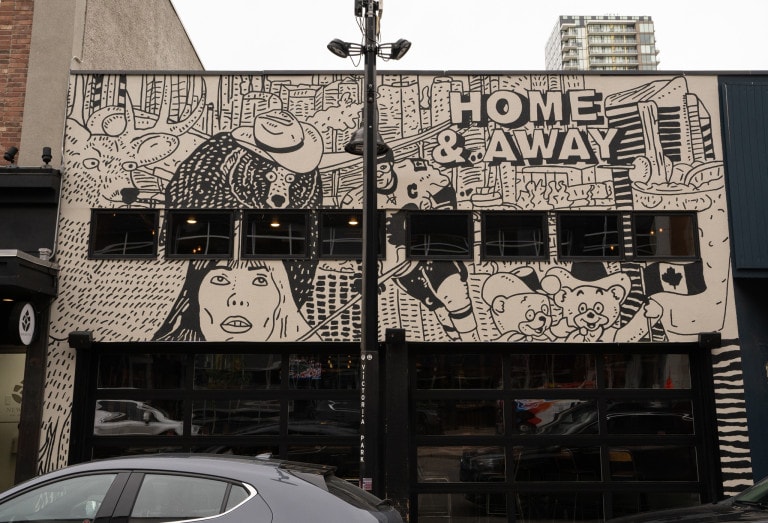
    You’ll find the Chinese zodiac hidden across the mural, in traditional Chinese lettering is the mention of home of the ginger beef and the Bow River, and some fun characters are playing around the mural that weren’t depicted in the original, such as a fisherman on the boat.

    The mural is 135 feet wide and 55 feet tall. We two of us painted the mural using a boomlift and paint sprayer/spray cans over the course of 40 days during the hottest August in 10 years. We had assistance with the traditional Chinese characters to ensure stylistic accuracy.

  • The Eau Claire Lumber Company

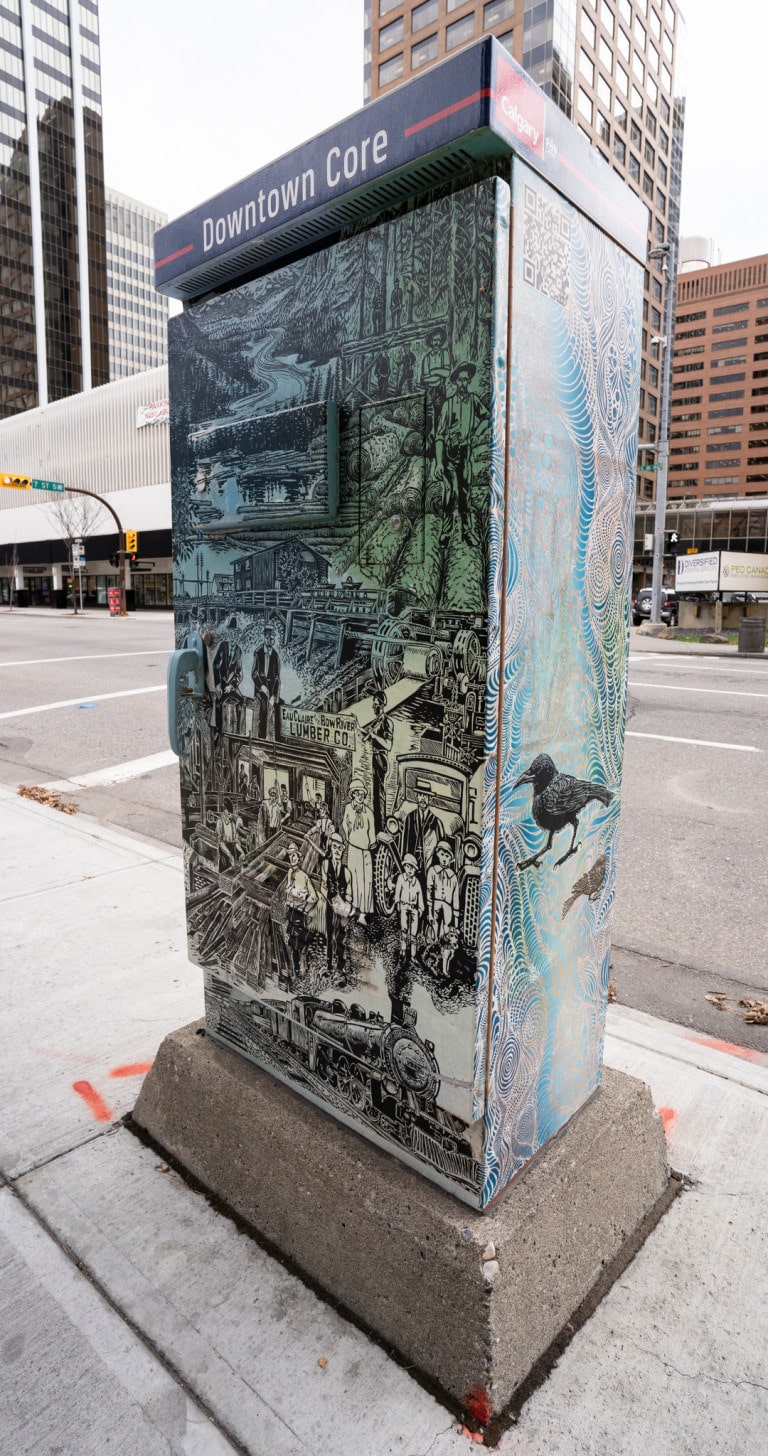
    This large woodcut by Eveline tells the story of the lumber mill, from logging in the Kananaskis area, floating the lumber down the Bow river to Prince’s island, to the sawmill in the City. The river also generated electricity for the lumber mill. The mill was relocated to heritage Park and can be seen there. Much of the wood was used for the railway stays of the developing Canadian Pacific Railway company.

  • N/A

    The concept for Claire Coutts’ portion of the utility box project was in collaboration with Sylvia Arthur. While researching, discussing with people in the area and loitering by our location, Sylvia and Claire noticed similar things. The area has a lot of pedestrian foot traffic, but few people who aren’t in transit to somewhere else. Claire began to think about the contrast of public and private for residents in a downtown setting. She created these linocuts of hands involved in domestic activity in contrast to Sylvia Arthurs imagery of industrial cranes skyline buildings, bridging the gap between the visible and invisible in an urban setting.

  • N/A

    This mural was designed for Parks Canada to raise awareness for the White Bark Pine Tree- an endangered species in the National Parks. after a National Artist call out that Parks Canada I was so honoured to be chosen to design and paint this mural

  • Bones of our Past

    This is a piece that speaks towards the history of the residential school system and powerfully depicts the survival and strength of Indigenous people, even through historical violence. Kalum paints a girl in traditional regalia with her buffalo skull staff, ravens fly around her ushering her forward. This mural sits high above Mohkinstsis, on High Park and should serve as a reminder of what it really means for all of us to exist on this land, and how much more work there needs to be done for true reconciliation. At BUMP we hope to continue programming incredible Indigenous muralists whose public art shifts our perspectives in real time, whose transformation of public spaces around the city is necessary and profound.

  • Nakoshiw – Emerge

    This piece was created to reflect the emergence of a new generation of Métis and Métis artists reconnecting with their culture, homelands, medicines, and Kin. Riel is often referenced and quoted when it comes to the emergence and depiction of our people. In this mural I wanted to reference my Cousin Valarie Campbell as a young matriarch.

  • Unnamed

    Exploring the shared iconographic relationships and cultural usage of Buffalo, Deer and Elk hide in First Nation cultural storytelling in addition to the Romanticised ‘Western’ Aesthetic of North America.

  • Buffalo Nations Stand and Be Noticed

    The Buffalo with the Camp and simple landscape represents all the Buffalo Nations that hunted and lived off the Buffalo. The dragonflies represents the month
    of August and also I wanted to tie the Beltline mural project with it…. during August and late July the dragonflies are in full effect and is good to help time the
    changes in the seasons. Under them are traditional otter designs which are common design in Treaty7 territory. The riders are youth and elder riding together
    representing parenting, mentoring, and the balance.

  • Entanglements

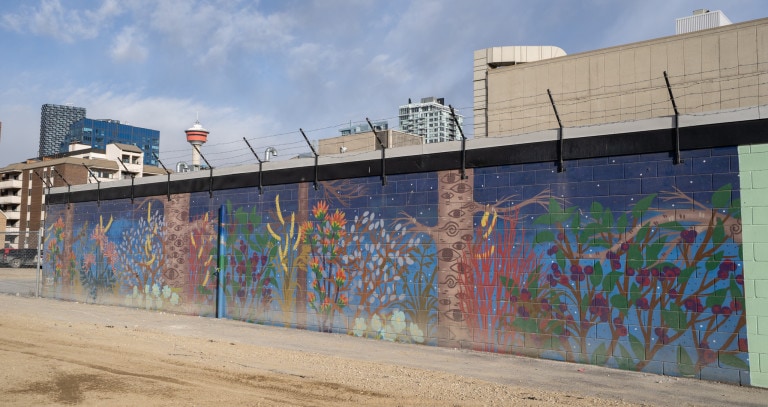
    I have a deep appreciation for the place-based nature of murals, so usually when visiting a place to paint a mural I start by getting a sense of the Calgary area including the flora and fauna. I have done this many times, but the process of studying the Calgary ecosystem in Calgary was peculiar because it was so
    familiar to me; I had lived in Alberta (including Calgary) for my entire life until I left ten years ago. The beings I was learning about as I spoke to Calgary experts, read books and websites, and walked around Inglewood Bird Sanctuary, including aspen trees, grasses such as grandma’s eyelash, dogwood, and pussy willow, had surrounded me when I was young to the extent that at one point I thought they were everywhere and saw right past them. What I once thought of as ubiquitous is actually very fragile and rare: the grassland ecosystem is among the most endangered in the world due to monocropping (see this photo we took on the way out). These discoveries had me reflecting on how strange and interconnected our lives are and visiting an old city had me doing the same, so I represented this through creating a dense study of plants interlocking with each other. The Calcutta Cricket Club has already created an environment full of lush natural beauty, so it was a nice place to create a mural encouraging passers by to see their natural surroundings with fresh eyes.

  • Tinkiling & B-Boy

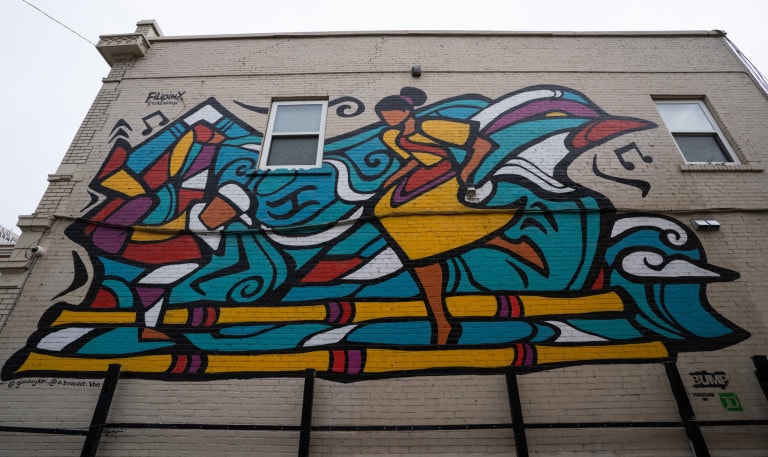
    This mural highlights the importance of dance in FilipinX culture through the ages. The FilipinX dancer on the right is doing a traditional dance called the “Tinikling”, mimicking a bird’s speed and grace as it navigates bamboo poles. The bird behind the woman is known as “Tikling” which is what inspired the traditional dance.