Faith of Our Fathers II
The work, painted by John Kuna, tells the story of the Islington United Church from its early Wesleyan Methodist days on Dundas to its current location at 25 Burnhamthorpe Road.

Mural Locations

The work, painted by John Kuna, tells the story of the Islington United Church from its early Wesleyan Methodist days on Dundas to its current location at 25 Burnhamthorpe Road.

The mural is part of Amnesty International’s Project Urban Canvas, a mural series celebrating the 60th anniversary of the Universal Declaration of Human Rights. This richly symbolic mural, designed by a team of youth artists, portrays the passage of a gift from left to right, on a journey that arrives ashore on a sea of waves – representing a difficult journey towards human rights that settles on the shores of our communities.

This mural depicts a scene from the prohibition era (ca. 1928) with a pop truck rounding up empty bottles outside of the old Islington Hotel, which was once a local watering hole.

The mural is part of Amnesty International’s Project Urban Canvas, a mural series celebrating the 60th anniversary of the Universal Declaration of Human Rights and focuses on article #28 of the Universal Declaration of Human rights which states: “Every individual is entitled to a social and international order in which the rights and freedoms set forth in this declaration can be fully realized”. Each youth artist was responsible for creating a panel sharing opinions regarding Freedom and ‘Entitlement’. Images of education, human rights leaders, and different stages of life, rights to owning property, and a unity tree are some of the dominant images present throughout the mural.
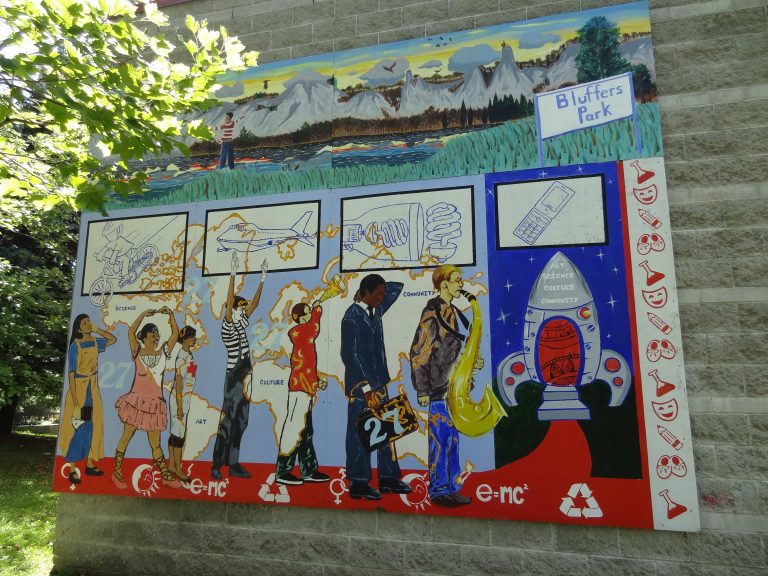
Created in Summer 2008 by local youth, this mural symbolizes the evolution of community as it celebrates strength and diversity through creative participation.

Painted by John Kuna, in this mural we see Mimico Creek winding through the valley, framed by sumac, spruce and pine, with Montgomery’s Inn shown at right.

The mural, painted by artist John Kuna, depicts Gordon’s Dairy, a local landmark once located in this building.

The theme of a “media art gallery” was chosen by the youth to reflect their views on how media and advertising affect youths today. Each youth artist created an individual piece within the mural to comment on issues of materialism, body image and self-reflection.
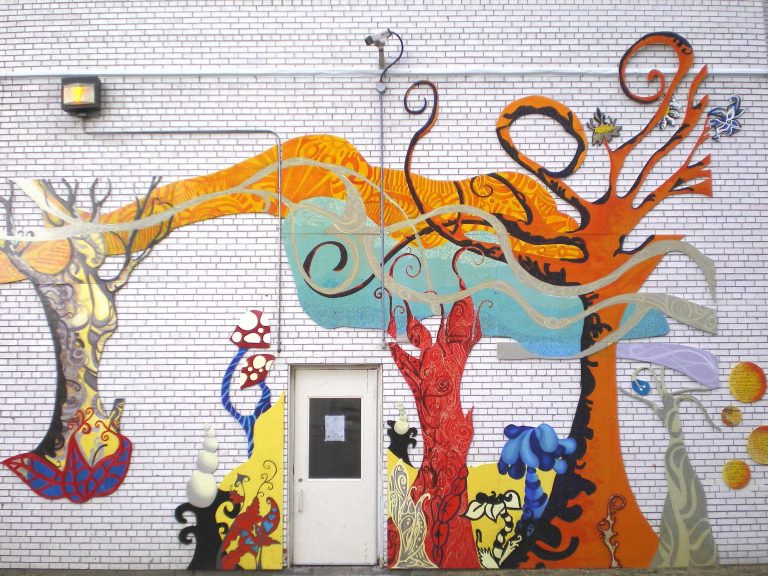
“Like the branches of a tree, mingling with the roots of a mushroom, touched by the butterfly’s antenna and caressed by nature’s wind. Different elements and organisms co-existing to ensure life’s progression – we too exist in this organic beauty.”

From 1917 to 1931 the old Guelph Radial Line, that ran behind this site, linked communities from Lambton Mills to Guelph. To evoke feelings of nostalgia, artist John Kuna used a painterly style recalling old coloured postcards and turn of the century paintings.

Also known as the Gunn house, Briarly was built in the 1840s. Although the heritage community lobbied to save the home from demolition, Briarly was demolished by developers in August 1989. This mural, by artist John Kuna was designed not only to illustrate a part of Islington’s history but also to convey a sense of comfort, peace, home and family. Rather than becoming a theme of mourning and end, it is instead conceived as an image of endurance and renewal.

This mural by Bill is painted on the two abutment walls and four centre columns of the bridge crossing Sheppard Ave. just west of Leslie Street. It was completed in October 2006.
It is a collaboration between Mural Routes, the City of Toronto Culture and Urban Planning Section.
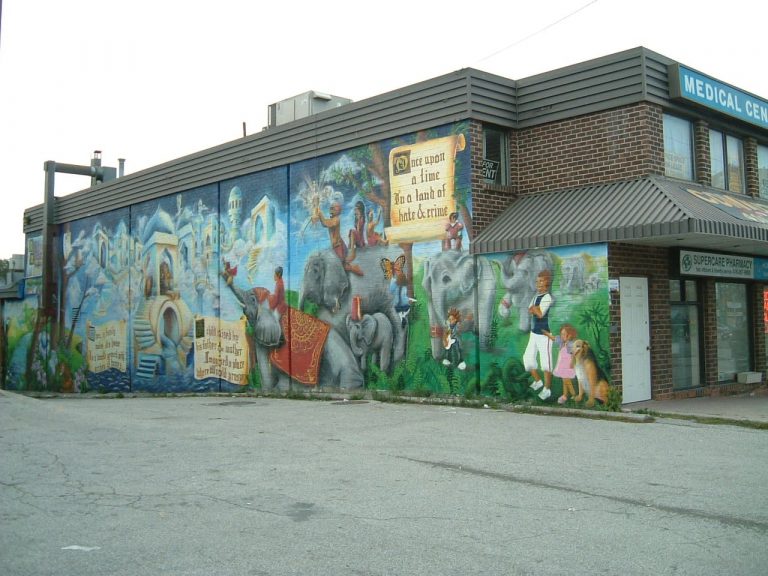
The theme of this mural – Natural Mystic – is “New Beginnings”. It portrays a family’s journey and their will to reach a safe and peaceful destination in which to live, a need that we feel is shared by all humans.

Working with themes of metamorphosis, transition and migration, members of Bluffers Tales told a series of stories to the mural artists, which were then translated into a design that celebrates the experiences of community members who left their homes to come to Canada.
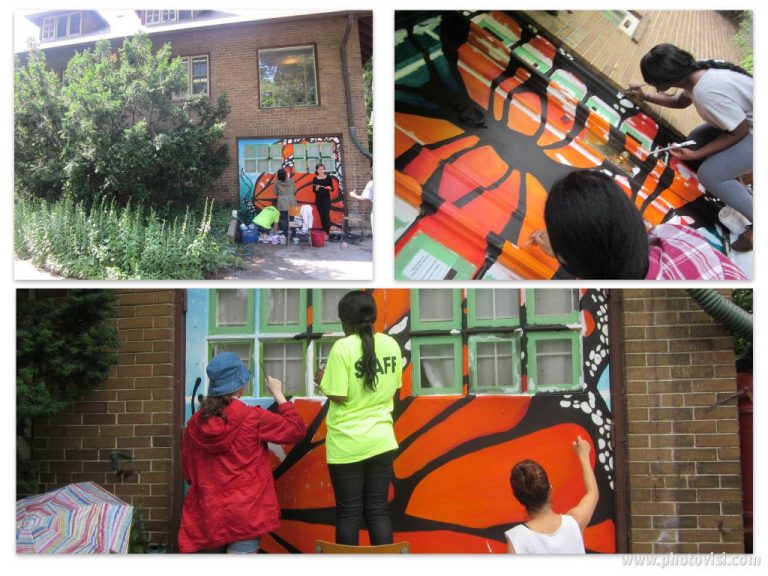
This mural is painted on the garage door of the office that Mural Routes shares with Scarborough Arts.
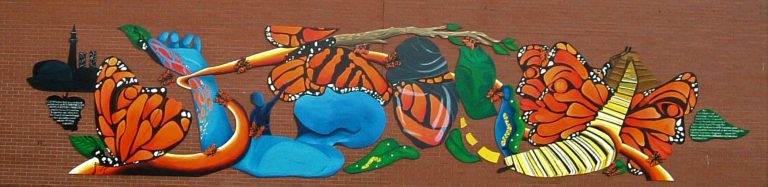
Flight explores themes of migration, transition, and change – inspired by the migration of the monarch butterfly.

Artist: John Ellenberger, 2000 Location: Pembroke, ON This unique 360º mural encompasses the vibrant history of CP Rail’s steam locomotives in conjunction with Consolidated Lumber Company Ltd. with the Ottawa River the background. A multi-media artist, John has produced many award-winning products. He is now co-owner of Little John’s Custom Painting in Garson, Ontario. Sponsors:…

An eight acre island in the Muskrat River was transformed into a garden sanctuary 1925-1950 by Mrs. Annie Gray Keith. Queen Juliana’s children played here while visiting during World War II. The park was donated to the City in 1962.
Sponsored by the Pembroke Horticultural Society

The mural, entitled “Mitchell’s General Store”, depicts life in surrounding community of Birch Cliff in the early part of the century.

The Unity Mural, painted by Marillyn Saffery (1998) and designed by Barbara Blackstein. The mural illustrates the diversity of people who live in this region.
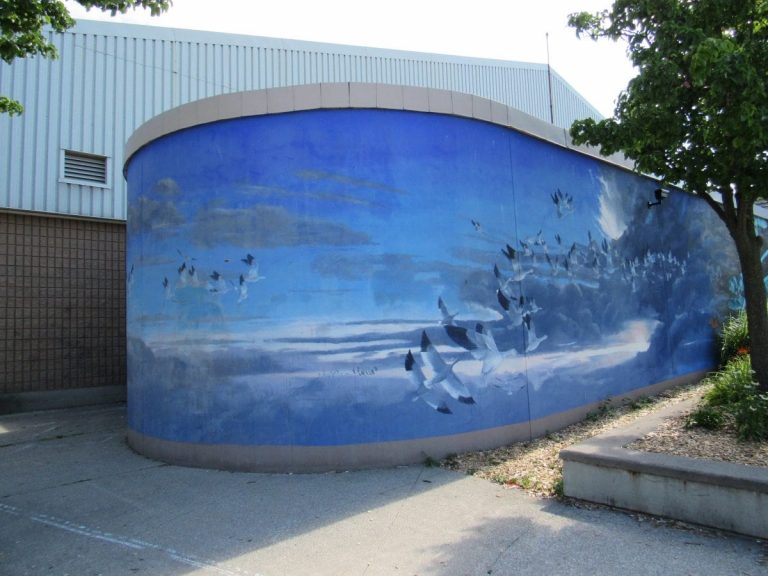
The artist, David Wright, used the idea of migration and arrival for the mural. The main artistic intention was to create a mural that was suggestive rather than explicit, seduce the eye and leave itself open to interpretation. The mural reads from left to right, culminating at the entrance doorway of the community centre. In the mural, you can find the migrating Canada snow geese transforming into monarch butterflies that arrive and alight on a fishpond.
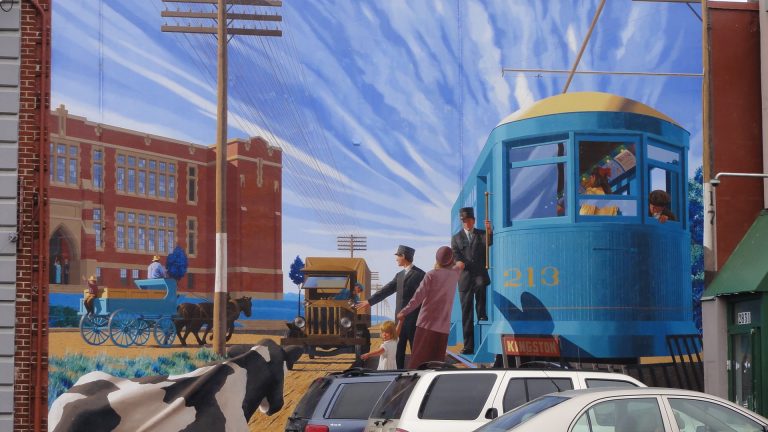
This commemorative mural depicts passengers boarding a radial car at Stop 17 on the Toronto and York Radial Line, at the junction of St. Clair Avenue and Kingston Road.

This mural recreates a scene showing members of the Highland Creek community working together to build an addition to the Wesley Methodist Chapel in the early winter of 1867. Present day residents, businesses and community groups of Highland Creek have joined together with the same spirit of cooperation and vision of their forebears to make this project a reality.

The unique “double” mural, painted on facing walls by Phillip Woolf, depicts two eras in the life of Spooner’s Garage. Built in 1926 and rebuilt in 1947, the garage was located on the south side of Kingston Road in Cliffside Village.
Sign up for our newsletter to get the latest news and events delivered straight to your inbox.
I have read and agreed to the Privacy Policy and the Terms of Service.
I understand that I can unsubscribe at any time by clicking the unsubscribe link in the Mural Routes newsletter.