SÔHKÂTISIWIN
ᓲᐦᑳᑎᓯᐃᐧᐣ, meaning “sôhkâtisiwin” or strength/power in Cree, and it depicts B-Girl and traditional fancy and hoop dancer, Angela Gladue. The mural is based on a photograph taken by Calgary photographer, Candice Ward.

Indigenous mural art, painted by First Nations, Métis, and Inuit people, reflects their contemporary and traditional values, stories, experiences, and ideas.
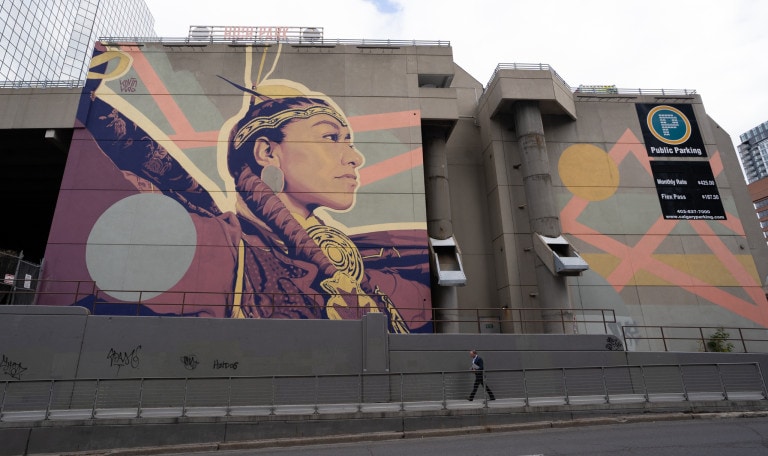
ᓲᐦᑳᑎᓯᐃᐧᐣ, meaning “sôhkâtisiwin” or strength/power in Cree, and it depicts B-Girl and traditional fancy and hoop dancer, Angela Gladue. The mural is based on a photograph taken by Calgary photographer, Candice Ward.
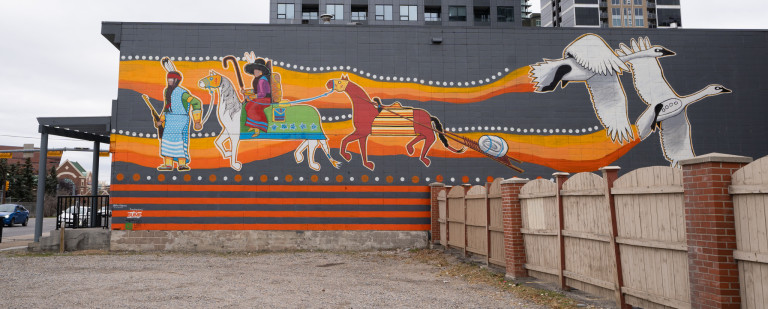
In this mural artwork I felt like I needed to make something that has an orange background as a reminder of the poor 215 babies who were found and how that number is in the thousands presently and the realities of the “generational impact” that the residential school had to this day. I am relearning my language because of that and I used my art to help save my language.
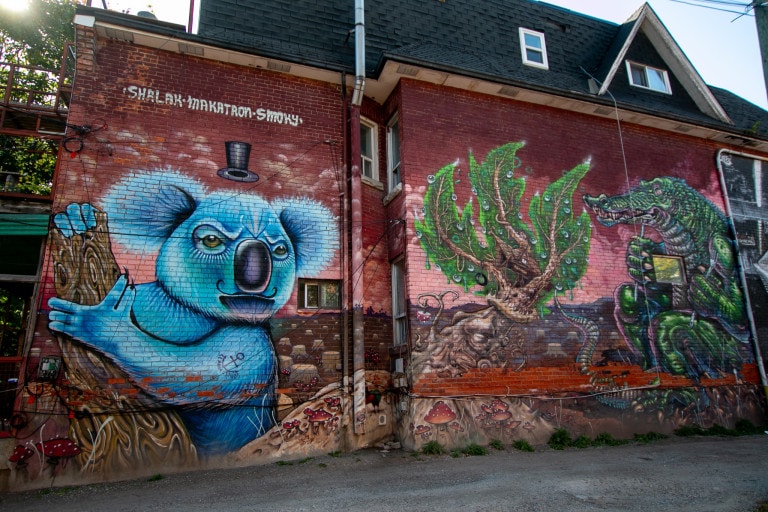
“The revenge of the killer koala… sneakily disguised as Mr. Hipster, he was going to reclaim his territory and regrow his family’s traditional forest..! This is his portrait of right before it all went down!”

This piece was created in collaboration with both Kayla Bellerose and Mackenzie Brown. The portrait of Amy wearing a buffalo robe is a recreation of an original photograph by Yamuna Flaherty, a photographer and friend of Amy’s. The circle behind Amy’s portrait is the sun with 7 beams of light representing the 7
Sacred Teachings of Truth, Honesty, Respect, Humility, Love, Wisdom, and Courage. Amy Willier embodied these teachings with the way she lived her life with family and community. The symmetrical butterflies represent the transformation of coming from darkness into light, and we chose the colour orange to honour
the children being found at unmarked mass graves in residential schools across Canada, and green to honour the intergenerational healing of our future generations. Amy advocated for Orange Shirt Day for years, so we know that she is now a helper in the spirit world bringing home the children who never
made it back to their family.
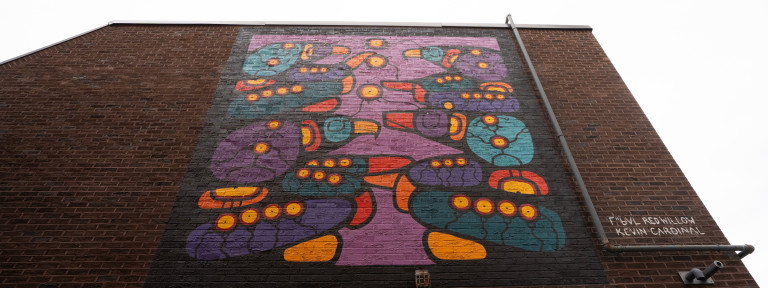
“The design will represent a healthy, co-operative relationship between the Native culture and the community. In my artwork I use bold black lines and vibrant lively colors reminiscent of the woodland style of art. I use animals such as birds, bears, wolves, eagles, beavers, ravens and buffaloes to represent people or groups of people, and also to represent spiritual beings. I use circles to represent thoughts, ideas, statements, words, concepts, and principles. Whether you are driving or walking by the artwork, I am hoping that the art piece will aid in promoting a cooperative relationship and bring healing and unity to the community.”
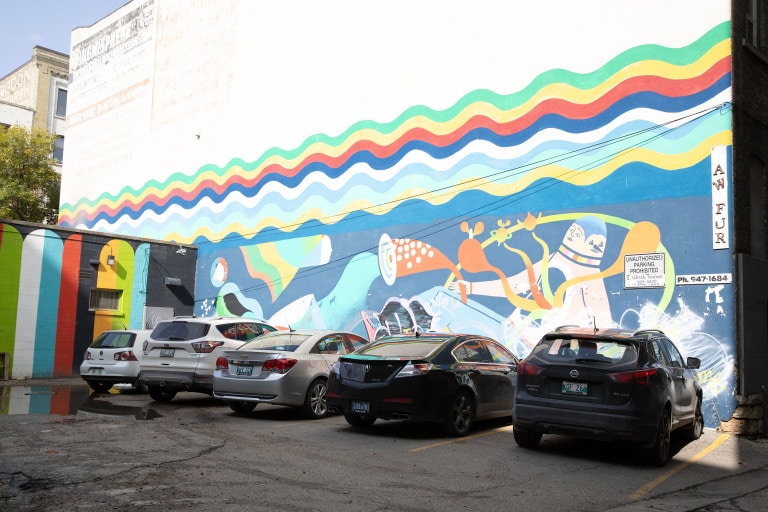
Located on the south wall of the Hemisphere Building in the deer+almond parking lot, this mural was a continuation of a project done by Kenneth Lavallee. In 2013 he painted a mural during Nuit Blanche Winnipeg in 2013, and the following year he found himself collaborating with 3 other artists on a mural on the neighbouring wall. A year later in 2014, Lavallee added the waving lines to the second story of the mural.
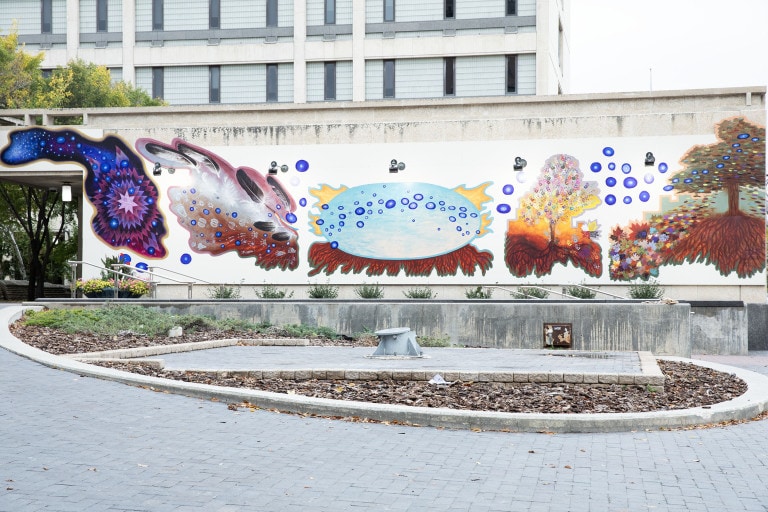
Located at Winnipeg’s City Hall, this mural was commissioned for the city of Winnipeg’s long term commitment plan to equity, diversity, inclusion and anti-racism. It is meant to show our interconnectedness to Mother Earth, with a maple tree blowing leaves which transform into orbs which contain spiritual energy. This mural is made up of 5 panels, each piece having the option of one day being displayed separately. It is planned to be a traveling mural, and will be installed on other city facilities.
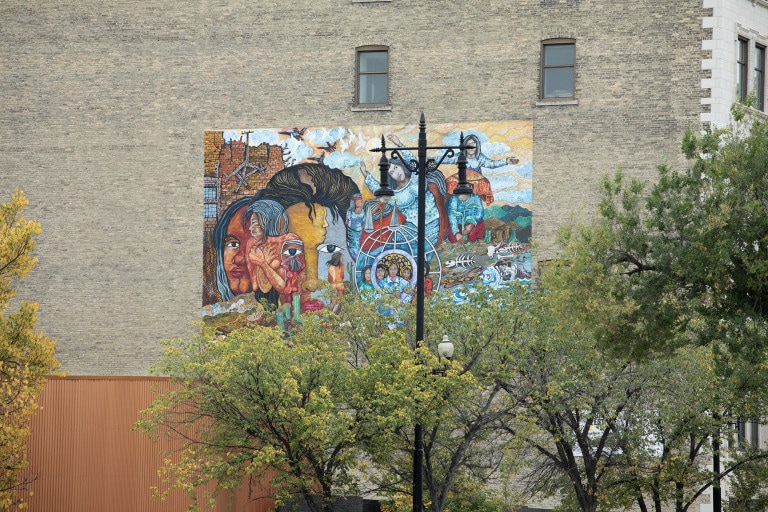
A semi-finalist in Mural Fest 2K7, this mural brings up the ideas of peace, environmental protection and gender equality. It depicts two different ways in which women are perceived, one way is more neutral while the other is more sexualized. It also shows the ways in which women can be a major force in our journey to a more peaceful, and equitable society.
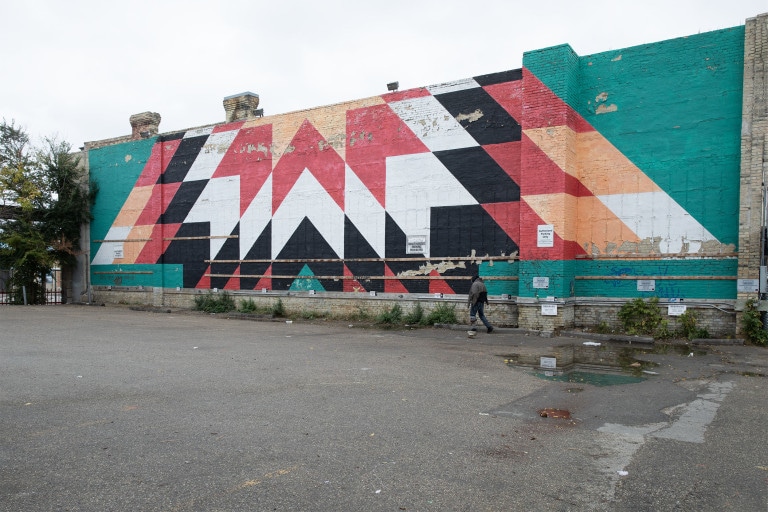
Part of Wall-to-Wall mural festival, Winnipeg artist Kenneth Lavallee led the Star Blanket Project, which first consisted of painting star blankets on buildings in Winnipeg’s North End. Many other star blanket murals have been created throughout Winnipeg and Brandon since then. The murals honour missing and murdered Indigenous women, this dedication coming from Lavallee learning more about the 1971 murder of Helen Betty Osborne. Sponsored by Synonym Art Consultation, Graffiti Art Programming, North End Community Renewal Corporation, Wall to Wall Mural Festival.
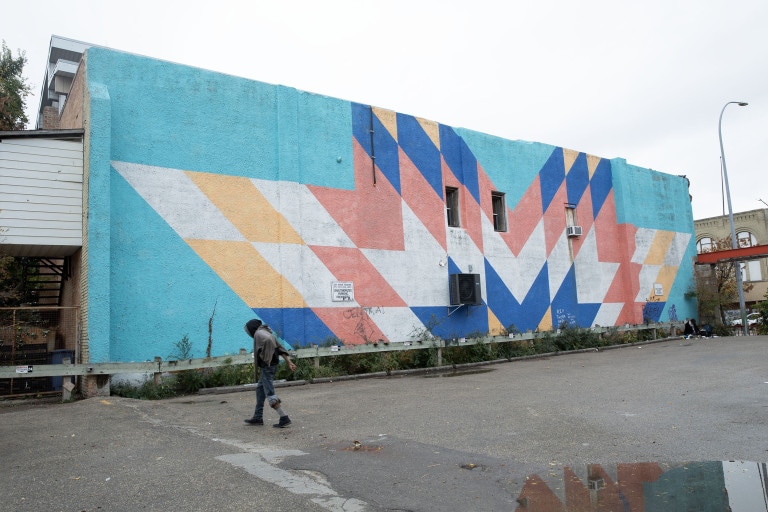
Part of Wall to Wall Mural Festival, Winnipeg artist Kenneth Lavallee led the Star Blanket Project, which first consisted of painting star blankets on buildings in Winnipeg’s North End. Many other star blanket murals have been created throughout Winnipeg and Brandon since then. The murals honour missing and murdered Indigenous women, this dedication coming from Lavallee learning more about the 1971 murder of Helen Betty Osborne. Sponsored by Synonym Art Consultation, Graffiti Art Programming, North End Community Renewal Corporation, and Wall to Wall Mural Festival.
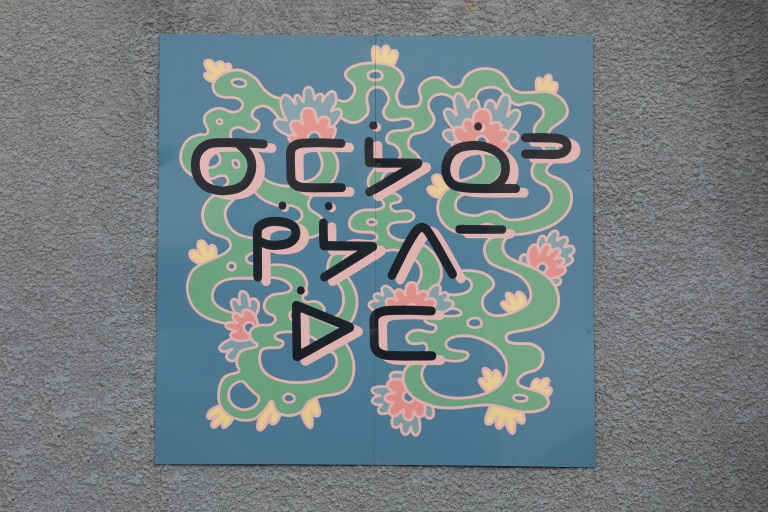
Artist Statement: ““We’re still here” depicts an illustration created with the focus of sharing artwork that can be recognized by other Indigenous people through the use of Cree syllabics; a writing system used to depict Cree dialects. With the help of their mother, Diana Morrisseau, they had both decided on the phrase nitayānān kīyāpic ōta which in Cree translates to “we’re still here,” as a sign that indigeneity and indigenous artists/voices are still prevalent in today’s society. The image uses floral designs and patterns to display reciprocity and interconnectedness at the suggestion of their mother due to how important and integral floral designs are presented in indigenous beadwork, especially among Métis artists. By including floral designs in the artwork, it is also a way for them to show solidarity towards their ancestral background as a Métis and Cree artist.”
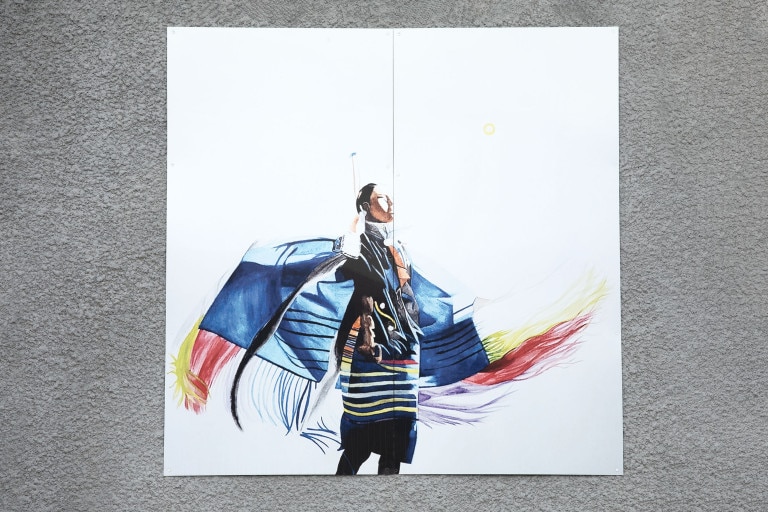
Artist Statement: “Fancy Shawl Dancer features Anishinaabe mother Billie Brandon from Waywayseecappo First Nation. The original piece is part of a Fancy Shawl Dancer series with this one being done in watercolor. It is part of the Provincial Art Collection of Manitoba. In this work, Jannuska is trying to capture the beauty of the regalia in motion.”
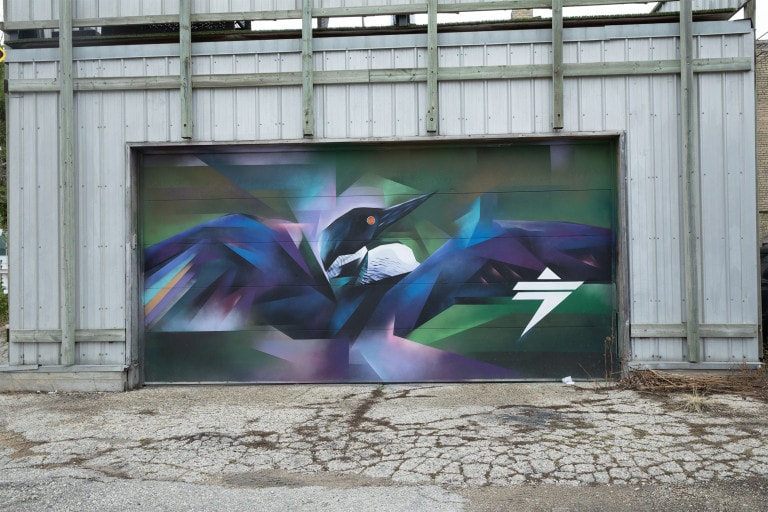
This mural painted on a garage door depicts blue bird with red eyes, in a soft, geometric style. To the right, the artist’s signature symbol is seen in white. Cash Akoza is a local Indigenous artist who has created numerous murals in Winnipeg.
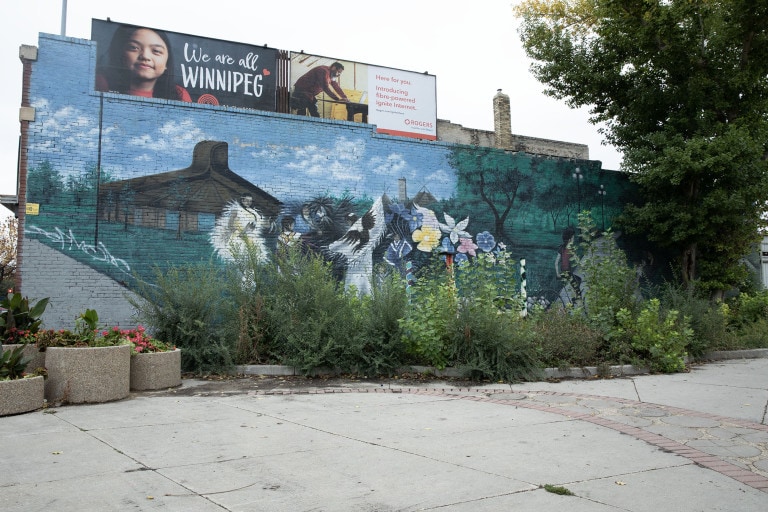
This mural depicts a park-like scene, with the recognizable Circle of Life Thunderbird Building in the distance on the far left. In the centre stands two teepees, with Indigenous people seen within and around them. An array of flowers flow to the right of this scene. The very right of the mural depicts a biker, riding down a forest bike trail. Sponsored by Downtown Winnipeg BIZ, and Take Pride Winnipeg!
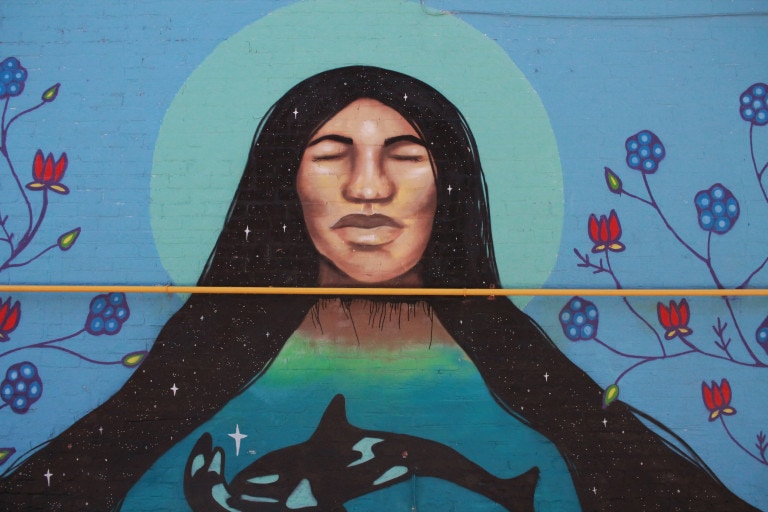
The Tahlequah mural visualises the story of Tahlequah, an orca who carried the body of her calf (Tali) for seventeen days following Tali’s death. For Mo Thunder, this mural is about community care. This mural was painted as part of WomxnPaintTO.
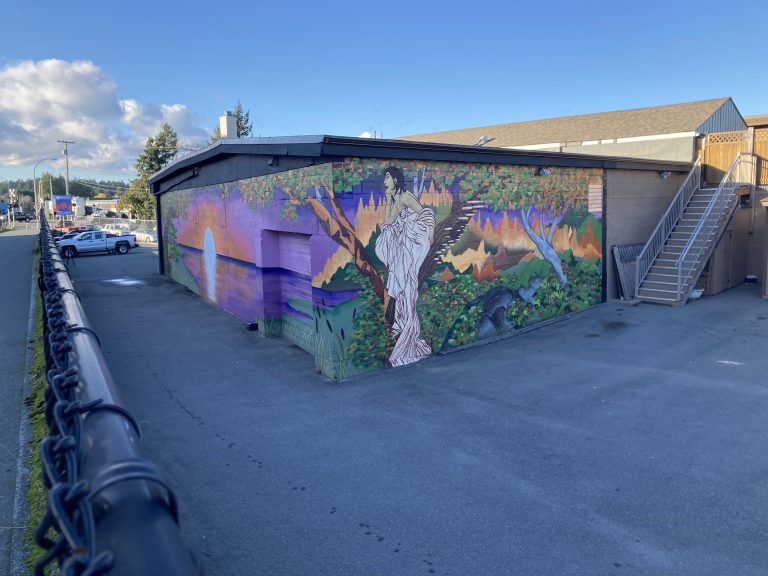
This mural was completed at Rootside Mixers as a part of the East West Mural Festival with ECAH.

This mural connects with the specific setting at the Library, as well as the surrounding neighbourhood. The upper portion of the artwork, visible from the street, features a fire, row of corn, and an extraordinary night sky, a spectacular setting for the central characters including a storyteller and those gathered to listen by the fire. In the lower corners of the piece, there are animals that will draw visitors into the setting. The muskrat is key to the Indigenous Recreation story, as following the great flood, the semiaquatic rodent brought life back to earth from the depths through a morsel of sand. Viewers will note that the muskrat has a bandolier bag, which has always been a part of First Nations and Native American attire. There is also a mother bear and cub in the design. Similar to the muskrat, the mother bear is wearing a bandolier bag, symbolizing that all of creation has been given a set of original instructions and responsibilities that they have always maintained. The animals are situated in the space to remind human beings that we share the natural environment. This is emphasized by how the bear and cub are positioned on rock formations that visually extend the reading garden amphitheatre. All living things are in the same spot. The bear is traditionally considered a protector and maintains a very close relationship to the earth.

This mural was created for the Up Here Festival in Sudbury, Ontario for a painted Power Box project. It is currently located at the bottom of the main steps into Bell Park, with the old painted hospital to your left. The artwork was created to commemorate my childhood memories of picking wild blueberries in my backyard in Sudbury. I’ve been away from my hometown for most of my life but coming back to create a piece of public art felt full circle and a source of pride. Miigwetch and thanks to the organizers of Up Here and the partnership of Greater Sudbury Utilities for the Power Up project.

Digital Mural for the Town of Aurora

Indigenous boy in front of one of Hamilton’s well known waterfalls – Albion Falls.
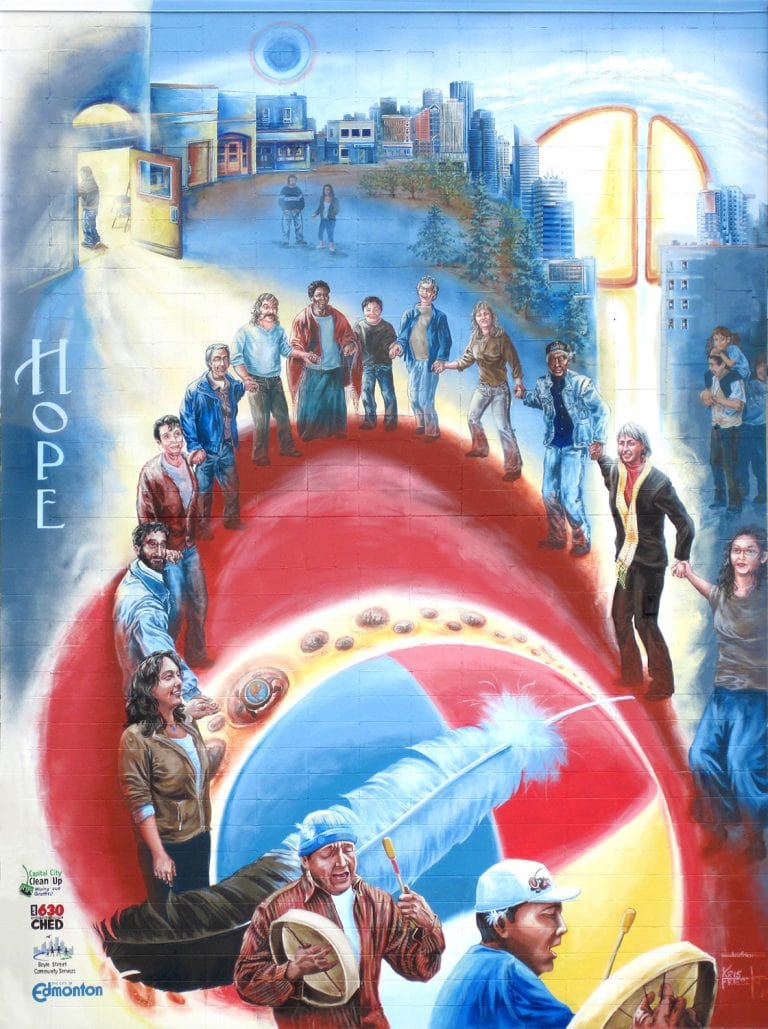
The Giants of Edmonton Mural Program celebrated Hope Hunter and the Boyle Street Community Services with this mural commission. The Boyle Street charity works to see all people grow healthier through involvement in strong, accepting and respectful communities. Hope is a mural inspired and influenced by First Nations people in Edmonton, and promotes the cultural aspects of inclusion, diversity, and putting people first.

PJ Gilhuly worked with Hume School students to create “Raven’s Eye View” on the side of Hume School. Makayla Taylor and the Nelson Youth Arts Action Committee also contributed to the creation of this piece.

PJ & Lyla Gilhuly painted this mural for the Nelson International Mural Festival 2020.
“PJ Gilhuly was joined by her daughter Lyla at NIMF 2020. PJ was born to Ktunaxa parents living in Cranbrook, BC, on September 3, 1975. Adopted by English/Irish parents, she grew up for the most part of her life in Ontario. After living away from her hometown for 30-plus years, she moved back to Cranbrook with her kids and settled in the small city and began a career as a self-taught artist. Most of her early sketches and charcoal work from depicting the human figure in scenes that suggest loneliness and suffering. Gilhuly’s expressive work is considered some of the most unique and appealing work and well represented as a Ktunaxa artist.”

PJ Gilhuly created “Raven Haven” for the 2021 Nelson International Mural Festival in the first-floor stairwell of the parkade.
Sign up for our newsletter to get the latest news and events delivered straight to your inbox.
I have read and agreed to the Privacy Policy and the Terms of Service.
I understand that I can unsubscribe at any time by clicking the unsubscribe link in the Mural Routes newsletter.